ONE BUSINESS / INSIGHTS / ARTICLE 02
How Geography and Scarcity Shaped the UAE's First Economic Opportunities
The Economic Foundations of Entrepreneurship in an Environment of Limited Resources

The economic history of the United Arab Emirates begins with a fundamental question: how do communities create economic opportunities when the natural environment places significant limitations on their productive activities? Long before the discovery of oil, the formation of the federation, or the construction of modern commercial infrastructure, the territories that would become the UAE were inhabited by communities that had to organize their economic lives around scarce freshwater, limited agricultural land, extreme climatic conditions, and the geographical separation of coastal settlements, desert territories, mountain regions, and inland oases. These conditions influenced not only where people could live, but also the kinds of economic activities they could develop, the resources they could mobilize, and the commercial relationships they needed to establish beyond their immediate surroundings.
The modern UAE is internationally recognized for its sophisticated infrastructure, global connectivity, diversified industries, and capacity to attract entrepreneurs and investment. Yet these contemporary achievements can obscure the very different circumstances under which the region's earliest economic foundations emerged. Before international airports, financial centers, free zones, and advanced logistics networks existed, economic survival depended upon the ability to identify productive possibilities within a demanding environment. Communities developed fishing, pearling, maritime transportation, oasis agriculture, animal husbandry, craftsmanship, and regional trade through combinations of environmental knowledge, practical experience, social organization, and commercial relationships. Economic development began not with the elimination of scarcity, but with the organization of human capabilities around the opportunities that scarcity made necessary to discover.
For contemporary entrepreneurs, this history offers an important analytical perspective. Economic opportunities do not emerge independently of their environments, and the existence of a potentially valuable resource does not automatically produce a successful enterprise. Opportunities must be recognized, evaluated, organized, and connected to demand through appropriate capabilities and relationships. The historical experience of the Emirates demonstrates how geography can simultaneously impose constraints and create possibilities, how limited resources can encourage specialization and exchange, and how economic activity develops through the interaction of people, institutions, knowledge, and markets. These relationships remain relevant to entrepreneurs entering the UAE today, even though the technological, institutional, and commercial conditions have changed fundamentally.
Geography as the First Economic Constraint and Opportunity
The territory of the present-day United Arab Emirates occupies a strategically significant position along the southeastern Arabian Peninsula, with access to the Arabian Gulf and the Gulf of Oman. Its geography includes extensive desert environments, coastal plains, islands, mountain ranges, and scattered areas where freshwater and suitable soil historically supported settlement and agricultural activity. These environments did not offer identical economic possibilities. Their differences influenced the distribution of population, the development of livelihoods, the movement of goods, and the formation of commercial relationships among communities.
The arid climate placed substantial limitations on agricultural production. Rainfall was generally low and irregular, freshwater resources were geographically concentrated, and high temperatures increased the difficulty of sustaining cultivation across extensive areas. In many locations, the absence of reliable water supplies restricted permanent settlement and made large-scale agricultural production impractical. Communities therefore depended upon a combination of activities adapted to their particular surroundings rather than upon a single dominant system of production.
Geography established the conditions within which economic decisions had to be made, but it did not determine those decisions completely. Coastal access created opportunities for fishing, maritime transportation, and trade, while oases supported cultivation and settlement where water resources permitted. Mountain environments provided different resources and routes of movement, and desert territories supported forms of mobility, pastoral activity, and exchange adapted to seasonal and ecological conditions. The economic significance of each environment depended upon the knowledge, tools, organizational practices, and relationships that communities developed to use its possibilities.
This distinction is central to understanding the historical foundations of the UAE economy. A territory may possess geographical advantages without developing the capabilities required to convert them into economic value. Conversely, communities facing substantial environmental limitations may establish productive activities by developing specialized knowledge, organizing labor, and connecting with markets beyond their immediate surroundings. The economic importance of geography emerges through the interaction between physical conditions and human capabilities.
For modern entrepreneurs, the same analytical principle applies when evaluating business opportunities in Dubai and the wider UAE. Access to international infrastructure, specialized economic zones, regional markets, or a particular commercial location may provide important advantages, but these advantages do not operate automatically. Their value depends upon whether an enterprise possesses the operational capabilities, customer relationships, financial resources, and organizational structure necessary to use them effectively. A favorable business environment creates possibilities; the enterprise must still determine how those possibilities can be transformed into productive activity.
Scarcity and the Economic Necessity of Specialization
Scarcity is one of the fundamental conditions of economic life because resources are limited relative to the different purposes for which people might use them. In the historical Emirates, scarcity was particularly visible in the availability of freshwater, fertile land, agricultural production, and certain materials necessary for settlement and construction. These limitations required communities to make decisions about the allocation of labor, the use of available resources, the organization of production, and the activities through which they could obtain goods that were difficult or impossible to produce locally.
The economic consequences of scarcity were not uniform. Coastal communities had access to marine resources and transportation routes but often faced significant agricultural limitations. Inland settlements located near oases could develop forms of cultivation that were unavailable across much of the surrounding desert. Other communities possessed specialized knowledge related to animal husbandry, navigation, construction, or trade. These differences encouraged the development of economic activities suited to particular environments and created opportunities for exchange among groups whose productive capabilities were not identical.
Specialization allowed communities to concentrate their efforts on activities for which they possessed relevant resources, knowledge, or geographical advantages. Fishing communities could supply marine products, agricultural settlements could produce dates and other crops, and merchants could organize the movement of goods between locations. Such activities did not eliminate scarcity, but they expanded the possibilities available to communities by connecting their productive efforts with those of others.
The emergence of specialization also created dependencies. A community concentrating on maritime activities might require agricultural products, construction materials, or other goods obtained through exchange. Agricultural settlements depended upon access to water, labor, tools, and commercial relationships capable of connecting their production with consumers. Economic organization therefore involved more than identifying a productive activity. It required the development of relationships through which goods, services, and resources could circulate.
This historical relationship between scarcity and specialization provides an important lesson for contemporary enterprise development. An entrepreneur does not need to possess every resource or capability internally to create economic value. Businesses can develop through specialization, supplier relationships, partnerships, distribution arrangements, and access to external expertise. However, these relationships must be organized carefully because dependence upon external resources also introduces operational and commercial risks. The relevant entrepreneurial challenge is to determine which capabilities should be developed within the enterprise, which can be accessed through external relationships, and how these different elements can be coordinated effectively.
Freshwater, Oases, and the Foundations of Inland Economic Activity
Water was among the most consequential resources shaping the historical geography of settlement in the Emirates. In an environment where rainfall was limited and agricultural possibilities depended upon reliable access to freshwater, oases and other locations with usable water supplies became important centers of economic and social activity. Their significance extended beyond the immediate production of food because permanent settlement created conditions for the accumulation of knowledge, the organization of labor, the development of local exchange, and the establishment of enduring community relationships.
Oasis agriculture required sustained knowledge of local environmental conditions, water management, cultivation practices, and the seasonal requirements of different crops. Date palms became particularly important in many agricultural environments because they were suited to the conditions of oasis cultivation and provided food and other useful materials. Agricultural activity could also include additional crops where water, soil, and local conditions permitted. These productive systems depended upon the careful use of limited resources and the coordination of activities necessary to sustain cultivation over time.
The economic value of an oasis was not limited to the water it contained; it also depended upon the productive system that communities organized around that water. Access to a resource established a possibility, but cultivation required practical knowledge, labor, tools, maintenance, and arrangements governing the use of water and land. The development of agriculture therefore demonstrates the relationship between natural resources and accumulated human capabilities.
Oasis settlements also participated in wider networks of exchange. Agricultural production could support local populations and provide goods for trade with communities whose livelihoods depended more heavily upon maritime activities, pastoral production, or other forms of specialization. These relationships connected inland and coastal economic systems and contributed to the movement of goods and people across the region. The resulting exchanges illustrate how geographical differences could support complementary economic activities rather than simply separating communities.
For entrepreneurs, the historical importance of oasis economies lies in the distinction between resource ownership and productive organization. A resource becomes economically significant when people develop the capabilities, institutions, and relationships necessary to use it effectively and sustain its value. This principle applies to contemporary enterprises seeking to use capital, technology, infrastructure, intellectual property, or access to particular markets. Possessing an asset is different from developing a productive system around that asset, and long-term economic value depends upon the effectiveness of the organization that connects resources with commercial purposes.
The Coast as a Gateway to Economic Opportunity
While the desert environment restricted certain forms of production, the coastline offered access to economic possibilities extending beyond the immediate resources of the Arabian Peninsula. Communities along the Gulf coast could participate in fishing, pearling, maritime transportation, and commercial exchange with neighboring territories and more distant markets. These activities made the sea an important source of livelihoods and a means through which economic relationships could develop across geographical distances.
The maritime environment presented opportunities but also imposed significant demands. Navigation required knowledge of coastal conditions, seasonal winds, currents, routes, and the practical limitations of available vessels. Fishing and pearling depended upon specialized skills, equipment, labor organization, and familiarity with marine environments. Trading activity required relationships with merchants and buyers, knowledge of commercial conditions, and the capacity to manage uncertainty associated with transportation and exchange.
The coastline was economically valuable not simply because it provided access to the sea, but because communities developed the knowledge and capabilities necessary to participate in maritime activity. This distinction helps explain why the development of a trading economy cannot be attributed exclusively to geographic location. A coastal settlement could possess access to commercial routes without automatically becoming an important center of trade. Economic development depended upon the ability to organize activities, establish relationships, attract commercial participation, and respond to changing conditions.
Maritime activity also connected local production with external demand. Goods produced or obtained within the region could be exchanged through networks linking the Gulf to neighboring commercial centers and the wider Indian Ocean. In return, communities could obtain products that were unavailable or difficult to produce locally. These relationships expanded the range of goods accessible to coastal populations and created economic roles for merchants, transport operators, suppliers, and other participants in commercial exchange.
The historical importance of these networks becomes especially clear when considered alongside the contemporary UAE's position in international trade and logistics. Modern ports, airports, and transportation enterprises operate through technologies and institutions fundamentally different from those of earlier maritime economies. Nevertheless, they continue to perform an essential economic function: connecting geographically separated markets and enabling the movement of goods, people, services, and commercial opportunities. The historical foundations of this orientation provide context for understanding why international connectivity became such an important element of the region's subsequent development.
Fishing, Pearling, and the Organization of Maritime Production
Fishing provided an important source of food and economic activity for many coastal communities. It required knowledge of marine environments, fishing methods, seasonal conditions, equipment, and the organization of labor. The value of fishing extended beyond immediate consumption because marine products could participate in local and regional exchange where preservation, transportation, and commercial relationships permitted. Fishing therefore formed part of an economic system connecting environmental knowledge with productive activity and community livelihoods.
Pearling developed as another significant maritime activity, supported by the presence of pearl oysters in the waters of the Gulf and demand from markets beyond the immediate region. The pearl economy involved diving, vessel ownership, labor organization, provisioning, financing arrangements, merchants, and trading relationships. The industry was therefore considerably more complex than the extraction of a valuable marine product. It depended upon the coordination of multiple economic activities and participants whose contributions were necessary to connect the resource with its eventual buyers.
The pearl economy demonstrates that the existence of a valuable natural resource does not automatically create a functioning industry. The commercial value of pearls depended upon the capacity to organize extraction, provide equipment, mobilize labor, arrange financing, establish relationships with merchants, and access markets where demand existed. Each stage required capabilities and resources that were not contained within the pearl itself. Economic value emerged through the organization of the activities that made production and exchange possible.
The industry also illustrates the risks associated with dependence upon external demand. The economic fortunes of pearling communities were influenced by conditions in markets that local producers could not fully control. Changes in purchasing power, consumer preferences, competition, and production technologies could alter the commercial viability of the activity. The later decline of traditional pearling demonstrates how industries built around established sources of demand may become vulnerable when their external economic conditions change.
For contemporary entrepreneurs, these historical relationships provide lessons concerning the design and sustainability of business models. Revenue depends not only upon the existence of a product or service, but also upon the continued operation of the relationships that connect that offering with paying customers. Enterprises must consider their dependence upon suppliers, financing, distribution channels, market demand, and technological conditions. The stronger the concentration of dependence upon a single activity or market, the more important it becomes to understand the risks associated with changes in that environment.
Trade Networks and the Expansion of Economic Possibilities
The historical communities of the Emirates were not economically isolated from the wider world. Maritime and overland relationships connected settlements with neighboring territories and commercial networks extending toward Persia, India, East Africa, and other parts of the Indian Ocean economy. The character, scale, and importance of these relationships varied across periods and locations, but they demonstrate that international commercial exchange was part of the region's economic history long before contemporary globalization.
Trade expanded economic possibilities by allowing communities to obtain goods that could not be produced efficiently or reliably within their own environments. It also created opportunities for individuals and groups capable of organizing transportation, identifying demand, connecting buyers and sellers, and managing commercial relationships. These functions required knowledge of products, prices, routes, trading partners, and the practical conditions governing transactions.
Commerce allowed economic value to emerge from connectivity itself. A merchant did not necessarily need to produce the goods being exchanged to perform a valuable economic function. The organization of transactions, movement of products, provision of information, and development of reliable relationships could contribute to the functioning of markets. This characteristic of commercial economies helps explain why territories with limited natural resources can nevertheless develop significant economic activities through trade and intermediation.
The development of commercial relationships also required responses to uncertainty. Distance created difficulties in communication, transportation, and the verification of information. Seasonal conditions affected maritime movement, while political circumstances and market changes could influence the reliability of routes and trading partners. Merchants therefore depended upon accumulated experience, relationships, reputation, and practical judgment when conducting transactions across different environments.
For entrepreneurs considering the UAE as a base for international business, this historical experience illustrates an enduring principle: access to markets becomes economically meaningful when an enterprise can organize reliable relationships across those markets. International connectivity provides opportunities, but successful commercial participation requires operational capabilities, knowledge of customers and suppliers, appropriate contractual arrangements, and the ability to manage the risks associated with cross-border activity.
Economic Interdependence Between Coast, Desert, and Oasis
The different environments of the historical Emirates supported activities that were often complementary. Coastal communities possessed access to marine resources and maritime transportation, while inland settlements could develop agricultural or pastoral activities adapted to local conditions. Desert routes connected settlements and supported the movement of people, animals, and goods. These relationships contributed to systems of exchange in which the economic activities of one community could support the needs of another.
The significance of this interdependence lies in the way it expanded productive possibilities beyond the limitations of individual locations. A coastal settlement did not need to produce every agricultural good it consumed if exchange relationships allowed access to inland production. An oasis community could obtain marine products and imported goods through commercial connections with coastal settlements. Economic specialization and exchange therefore enabled communities to participate in broader systems of production and consumption.
Interdependence transformed geographical differences into opportunities for economic cooperation. The environments that limited particular activities also created reasons for communities to develop relationships with others possessing different resources and capabilities. These exchanges required transportation, information, trust, and practical arrangements capable of sustaining commercial activity.
Such relationships were not necessarily equal or free from conflict. Access to resources, control of routes, political authority, and differences in bargaining power could influence the conditions under which exchange occurred. Economic interdependence could create opportunities while also producing vulnerabilities and competing interests. Understanding these complexities is important because commercial relationships are shaped not only by mutual benefits, but also by institutions, power, uncertainty, and the distribution of resources.
Modern enterprises operate within similarly interconnected economic systems, although at vastly different scales. Suppliers, distributors, financial institutions, customers, logistics providers, technology partners, and regulatory authorities contribute to the environment in which businesses operate. The effectiveness of an enterprise depends partly upon its ability to understand and coordinate these external relationships. The historical connections among coast, desert, and oasis provide an early illustration of how economic activity develops through networks rather than through isolated productive units.
From Environmental Constraints to Entrepreneurial Capabilities
The economic activities developed by historical communities were responses to the conditions in which those communities lived. Fishing, pearling, oasis agriculture, animal husbandry, transportation, and trade required different combinations of knowledge, labor, equipment, relationships, and organization. These activities were not identical to modern entrepreneurship, and historical actors should not be described as operating contemporary business models or applying modern management frameworks. Nevertheless, their experiences reveal economic mechanisms that remain relevant to the study of opportunity development.
One of these mechanisms is the relationship between constraints and the development of capabilities. Environmental limitations required communities to acquire knowledge suited to their circumstances, organize activities around available resources, and develop relationships through which additional goods and opportunities could be accessed. These capabilities accumulated through experience, adaptation, and participation in economic activity. The capacity to create value depended not only upon what communities possessed, but also upon what they learned to do.
A second mechanism involves the relationship between opportunity and organization. The existence of fish, pearl oysters, fertile land, or maritime routes created potential economic possibilities, but these possibilities required organized activity to become productive. Labor had to be mobilized, equipment obtained, knowledge applied, and commercial relationships developed. The same distinction exists in modern enterprise formation. A promising market opportunity does not automatically create a business capable of serving that market.
A third mechanism concerns the importance of external relationships. Communities facing limitations in local production could expand their economic possibilities through exchange, while merchants and transport operators created value by connecting different participants. These relationships demonstrate that economic activity depends upon coordination among actors whose capabilities and resources are distributed across an economic system.
From the perspective of Entrepreneurial Business Architecture (EBA), these historical observations encourage a distinction among the identification of an opportunity, the capabilities required to develop it, and the organization necessary to sustain productive activity. This is a contemporary analytical interpretation rather than a framework attributed to historical communities. Its value lies in helping modern entrepreneurs examine how opportunities, resources, relationships, and organizational decisions interact under conditions of uncertainty.
What Geography and Scarcity Teach Entrepreneurs Entering the UAE
The historical foundations of the UAE economy provide several important lessons for entrepreneurs considering business formation, market entry, or commercial expansion in the country. These lessons should not be understood as direct instructions derived from historical practices, because the economic environment of the contemporary UAE differs profoundly from that of earlier communities. Their significance lies in the economic relationships they reveal and the questions they encourage entrepreneurs to examine.
The first lesson is that opportunity must be evaluated within its actual environment. A business idea may appear attractive because a market is growing, a jurisdiction offers favorable conditions, or an industry is internationally prominent. However, the viability of an enterprise depends upon the specific requirements of its customers, operations, resources, and competitive environment. Just as historical economic activities depended upon local geography and available capabilities, modern enterprises must be organized around the conditions of the markets in which they intend to operate.
The second lesson is that access to resources does not guarantee the creation of value. Capital, infrastructure, technology, commercial licenses, and geographic location can provide important foundations for enterprise development, but their economic significance depends upon how they are used. Entrepreneurs must determine which capabilities are required to transform available resources into products, services, and commercial relationships that customers value.
The third lesson is that specialization and connectivity can expand economic possibilities. Historical communities developed productive relationships because their resources and capabilities differed. Contemporary enterprises similarly benefit from understanding which activities they can perform effectively and which should be supported through suppliers, partners, professional advisers, or specialized service providers. These relationships can expand operational capacity, but they must be designed with attention to reliability, coordination, and commercial risk.
The fourth lesson is that dependence creates vulnerability when economic conditions change. Historical maritime industries were influenced by demand, technology, and external commercial circumstances. Modern businesses also face uncertainty involving customers, competition, regulation, financing, and technological transformation. Entrepreneurs should therefore examine the assumptions upon which their business models depend and consider how those models may respond to changing conditions.
The fifth lesson is that commercial capabilities develop through organization and experience. Economic opportunity becomes productive when people coordinate resources, apply knowledge, establish relationships, and execute activities effectively. The contemporary UAE offers sophisticated infrastructure and a wide range of business environments, but entrepreneurs remain responsible for developing the capabilities necessary to operate within them.
Together, these lessons suggest that successful business preparation requires more than selecting a jurisdiction or completing registration procedures. It requires an understanding of the relationship between market conditions, opportunity recognition, organizational capabilities, commercial relationships, and uncertainty. Historical analysis can contribute to this understanding by revealing how economic systems developed through the interaction of constraints and human responses.
Understanding the UAE Economy Through Its Historical Foundations
The modern UAE represents an economic environment fundamentally different from the territories that existed before petroleum development and federation. Its cities, industries, infrastructure, institutions, and international commercial relationships reflect transformations that occurred across successive historical periods. Nevertheless, the earlier economic foundations remain important because they reveal how communities developed productive activities within demanding environments and how geographical conditions influenced patterns of specialization, settlement, and exchange.
Understanding these foundations provides context for examining later developments in the country's economic history. The expansion of commercial infrastructure, the emergence of modern institutions, the transformation associated with petroleum revenues, and the diversification of economic activity did not occur in a territory without previous economic experience. Earlier communities had already developed relationships with the sea, the desert, inland agricultural environments, and international trading networks. The nature and scale of economic activity changed, but the historical record demonstrates that economic organization, commercial connectivity, and adaptation preceded the modern UAE.
For entrepreneurs, this perspective encourages a more informed understanding of the country as a place for enterprise development. Dubai's international commercial environment, Abu Dhabi's economic capabilities, and the distinctive opportunities available across the other emirates should be examined in relation to their specific institutional, industrial, geographical, and commercial characteristics. The existence of a successful national economy does not mean that every business activity is equally suitable for every location or that the same organizational model will perform effectively across different markets.
The study of economic history therefore complements contemporary business research by encouraging entrepreneurs to investigate how economic environments emerged, why particular activities developed, and what capabilities supported their expansion. A deeper understanding of a market does not eliminate entrepreneurial uncertainty, but it can improve the quality of the decisions made within that uncertainty.
Explore The Economic History of the United Arab Emirates
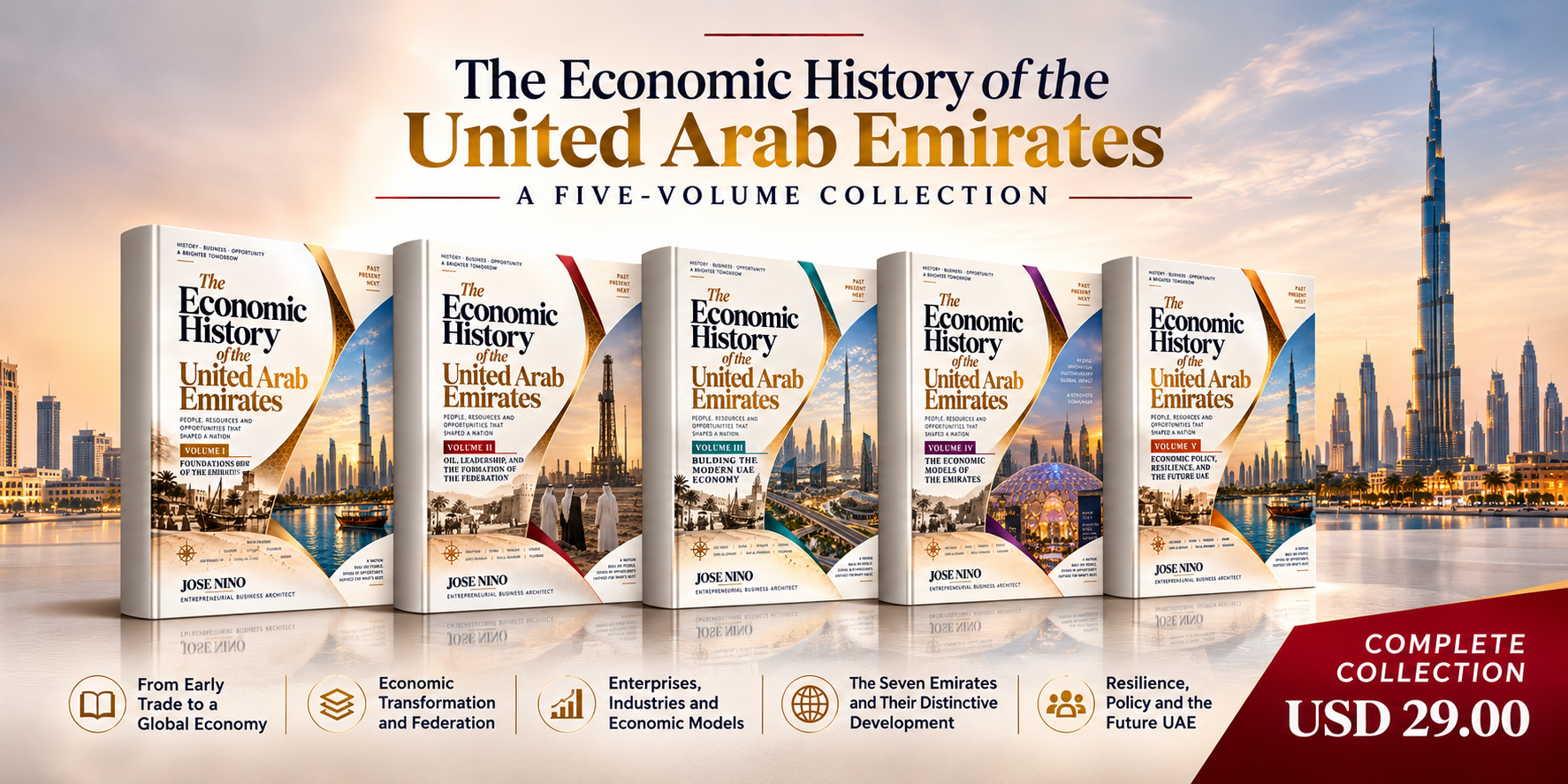
The Economic History of the United Arab Emirates examines the development of the country through a complete five-volume collection, connecting historical economic analysis with lessons relevant to entrepreneurship, enterprise development, and contemporary business decision-making.
The collection begins with Volume I: Foundations of the Emirates, which examines the geographical constraints, early settlements, maritime commerce, regional trading networks, political arrangements, and distinct economic foundations of the emirates before the transformations associated with oil and federation. The historical relationships explored in this article form part of that broader examination of how people, resources, and opportunities shaped the region's earliest economic development.
The subsequent volumes examine oil, leadership, and the formation of the federation; the construction of the modern UAE economy; the different economic models of the seven emirates; and the policies, resilience, and future challenges shaping the country. Together, the five volumes provide a structured perspective on the historical forces, institutions, enterprises, and strategic transformations that contributed to the development of the contemporary United Arab Emirates.
The collection also connects historical interpretation with Entrepreneurial Business Architecture (EBA), encouraging readers to examine the relationships among economic opportunities, resources, organizational capabilities, institutions, commercial networks, and entrepreneurial decisions. Its purpose is to develop a deeper understanding of how economic environments evolve and how entrepreneurs can use that knowledge to evaluate opportunities more carefully.
Discover the Complete Five-Volume Collection — USD 29.99
The complete five-volume digital PDF collection is available for USD 29.99, with all five volumes included. It offers entrepreneurs, investors, executives, business professionals, and students of economic development an opportunity to explore the economic history of the UAE through a comprehensive editorial work connecting historical foundations with contemporary entrepreneurial understanding.
Explore the Complete Five-Volume Collection — USD 29.99
From Historical Understanding to UAE Business Formation
Understanding how economic opportunities developed historically provides valuable context for entrepreneurs considering the United Arab Emirates as a location for establishing or expanding a business. However, translating that understanding into a functioning enterprise requires practical decisions concerning the intended business activity, the appropriate jurisdiction, licensing requirements, commercial operations, and the organizational resources necessary to begin operating.
The UAE offers different environments for business formation, including mainland and free zone jurisdictions with varying requirements and commercial characteristics. The appropriate company structure should be determined by the needs of the proposed enterprise rather than by the assumption that one registration option is suitable for every business. Entrepreneurs should examine the relationship between their intended activities, customer markets, ownership arrangements, operational requirements, and the regulatory conditions applicable to their proposed business.
ONE Business Dubai provides UAE Company Formation & Business Registration Services for entrepreneurs, founders, investors, and international companies seeking to establish commercial operations in Dubai and across the United Arab Emirates. Our services support clients in evaluating registration options, coordinating relevant requirements, and completing agreed company establishment procedures.
UAE Company Formation & Business Registration — Professional Fees from USD 1,200 + Government Fees
Professional service fees start from USD 1,200, excluding applicable government charges, commercial license fees, immigration-related costs, and other third-party expenses where required. The final scope and estimated cost depend upon the jurisdiction, proposed activity, and services requested.
Contact ONE Business Dubai for UAE Company Formation Services
Conclusion: Economic Opportunity Begins With Understanding the Environment
The earliest economic foundations of the United Arab Emirates demonstrate that scarcity and geographical constraints did not prevent communities from developing productive activities and commercial relationships. Instead, these conditions influenced the forms of specialization, knowledge, organization, and exchange through which economic life emerged. Coastal settlements developed maritime activities, oasis communities organized agricultural production around limited water resources, and commercial networks connected different environments with markets beyond the Arabian Peninsula.
These historical experiences reveal that economic opportunity is not determined solely by the resources available within a particular territory. It also depends upon the capabilities people develop, the relationships they establish, the institutions within which they operate, and their capacity to organize resources around productive purposes. The history of the Emirates illustrates how economic possibilities can expand when communities connect specialized activities, develop practical knowledge, and participate in wider systems of exchange.
For contemporary entrepreneurs, these lessons encourage a more thoughtful approach to market entry and enterprise development. Access to infrastructure, international markets, commercial licenses, or favorable business conditions can create opportunities, but those opportunities must be supported by appropriate organizational capabilities, operational decisions, and relationships with customers and commercial partners. The historical experience of the UAE reinforces the importance of examining the environment in which an enterprise intends to operate rather than assuming that the advantages of a location automatically produce business success.
Geography creates conditions. Scarcity shapes choices. Capabilities transform possibilities into economic activity. Understanding how these relationships influenced the earliest economic development of the Emirates provides a stronger foundation for examining the country's subsequent transformation and the opportunities available to entrepreneurs today.
Before deciding where to build a business in the UAE, understand how its earliest economic opportunities emerged.
Contact ONE Business Dubai for UAE Company Formation Services