ONE BUSINESS / INSIGHTS / ARTICLE 11
How the Discovery of Oil Transformed the UAE Economy: 12 Entrepreneurial Lessons in Resource Management and Economic Transformation
From Uncertain Exploration and International Partnerships to Petroleum Revenues, Strategic Investment, and the Economic Foundations of the United Arab Emirates
How the Discovery of Oil Transformed the UAE Economy: 12 Entrepreneurial Lessons in Resource Management and Economic Transformation
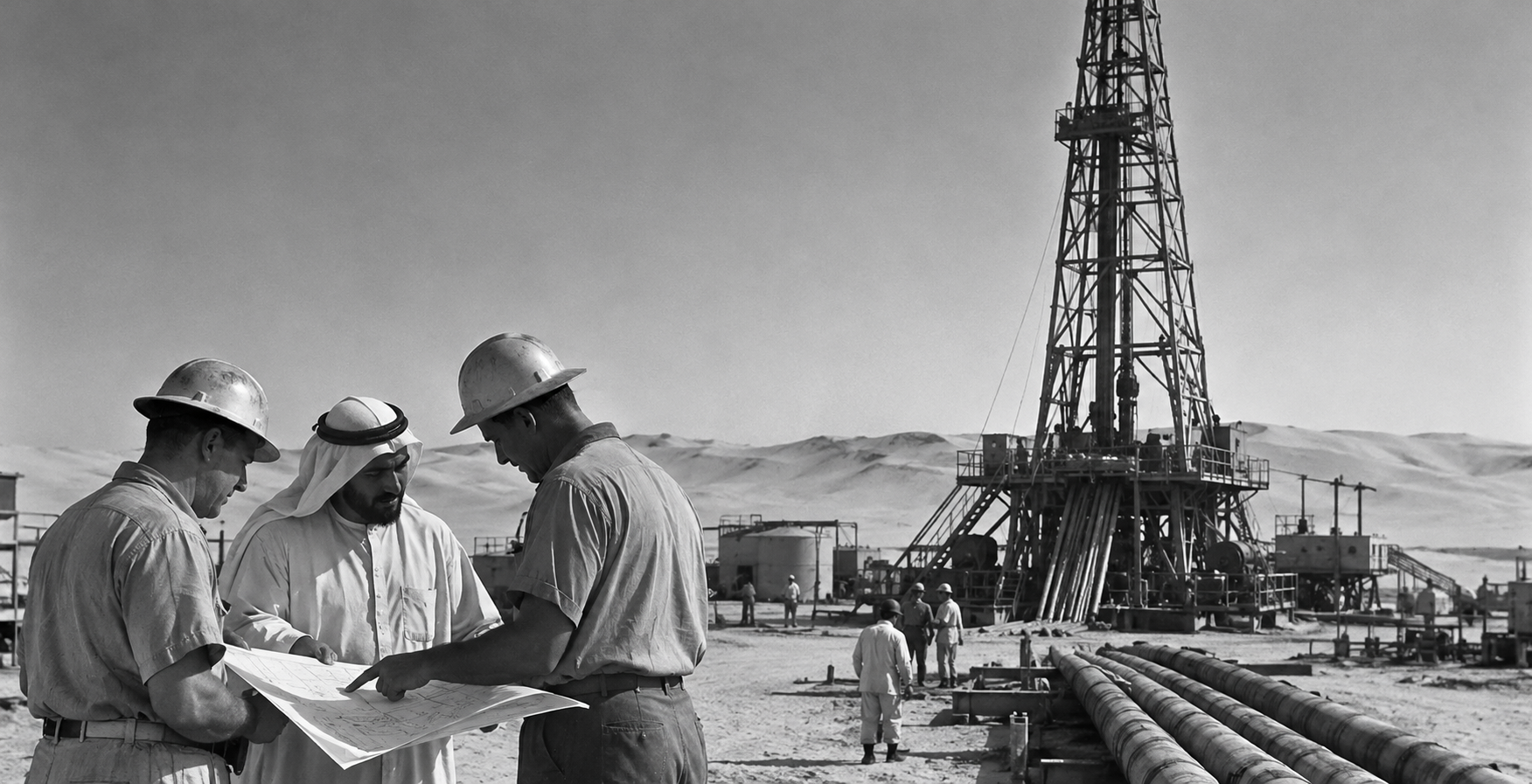
The discovery of oil in the territories that would become the United Arab Emirates was one of the most consequential developments in the economic history of the Arabian Gulf. Yet the transformation that followed was neither immediate nor inevitable. Long before petroleum revenues financed infrastructure, public institutions, and economic development, oil existed only as an uncertain geological possibility. International companies negotiated exploration rights, invested substantial capital, conducted surveys, and drilled wells without knowing whether commercially viable deposits would ever be discovered.
This distinction is fundamental to understanding the economic transformation of the Emirates. The discovery of a valuable natural resource can create extraordinary opportunities, but the existence of that resource does not automatically produce a prosperous economy. Between geological discovery and economic development lies a complex process involving capital, technical expertise, contractual arrangements, institutional capacity, infrastructure, investment decisions, and long-term strategy.
The historical experience of the Trucial Coast illustrates this process particularly clearly. During the early twentieth century, the economies of the individual emirates remained closely connected to maritime trade, pearling, fishing, agriculture, craftsmanship, and regional commerce. These activities had supported local communities for generations, but they operated within significant financial and environmental constraints. The decline of the pearling industry intensified economic difficulties, while the possibilities for large-scale infrastructure development remained limited.
International interest in petroleum began to change this economic environment before any significant local discovery had been confirmed. The growing importance of oil in transportation, manufacturing, and international commerce encouraged companies to investigate geological possibilities throughout the Gulf. Discoveries elsewhere in the region suggested that similar resources might exist beneath the territories of the Trucial Coast.
The first concession agreements emerged during the 1930s, establishing the contractual foundations for exploration. Yet decades would pass before the commercial possibilities of petroleum became clear. Abu Dhabi's commercially significant discoveries and the beginning of exports transformed its financial position, while Dubai's later discoveries created additional economic opportunities on a smaller scale.
The consequences extended beyond the individual territories possessing petroleum resources. Oil revenues changed the possibilities for infrastructure investment, public administration, economic cooperation, and ultimately the development of federal institutions. At the same time, the unequal distribution of petroleum resources created an important question: how could territories with substantially different economic capacities establish a shared political and economic future?
These developments provide valuable lessons for contemporary entrepreneurs. Although few businesses operate in the petroleum industry, almost every enterprise confronts comparable challenges involving uncertain opportunities, strategic partnerships, investment risk, resource allocation, financial management, and the conversion of potential value into sustainable economic activity.
Through the perspective of Entrepreneurial Business Architecture (EBA), the discovery of oil becomes more than a historical account of natural resources. It becomes a case study in how economic opportunities are identified, structured, financed, developed, and transformed into productive capabilities.
1. Entrepreneurial Lesson: Transformative Opportunities Often Begin Before Their Value Is Confirmed
The earliest petroleum exploration initiatives along the Trucial Coast were undertaken without confirmed knowledge that commercially viable oil deposits existed beneath the territories concerned. International companies were responding to growing global demand and discoveries elsewhere in the Gulf, rather than to established local production. Their interest represented a calculated willingness to investigate a possibility whose ultimate value remained uncertain.
This uncertainty is particularly important because historical accounts often describe oil discoveries from the perspective of their eventual consequences. Once petroleum wealth transformed Abu Dhabi and contributed to the development of the UAE, the earlier exploration period could appear to have been a straightforward progression toward an inevitable outcome. In reality, companies and local rulers faced decisions whose results could not be known in advance.
The growing importance of petroleum in the international economy provided evidence that exploration might be worthwhile. However, evidence of increasing demand did not establish that a particular territory contained commercially viable reserves. Exploration required capital expenditure before the fundamental commercial proposition could be confirmed.
Entrepreneurs encounter comparable conditions when identifying emerging markets. A new technology, changing consumer behavior, regulatory development, or unmet commercial need may suggest an opportunity before sufficient evidence exists to demonstrate that a profitable business can be established.
The entrepreneurial challenge is to distinguish between uncertainty that can be investigated and speculation unsupported by meaningful evidence. Founders should examine market developments, comparable businesses, customer needs, technical feasibility, and the resources required to test their assumptions. They must also recognize that some information cannot become available until an initial investment has been made.
The first entrepreneurial lesson is that transformative opportunities frequently require disciplined action before their value can be fully confirmed. Successful entrepreneurs investigate uncertainty systematically rather than waiting for guarantees that may never exist.
2. Entrepreneurial Lesson: Strategic Partnerships Can Unlock Opportunities Beyond Individual Capabilities
Petroleum exploration along the Trucial Coast required capabilities that local rulers and communities did not independently possess. Geological surveys, drilling technology, specialized equipment, technical personnel, and substantial investment capital were essential to investigating the region's potential resources.
International petroleum companies possessed these capabilities through their experience in other territories. Organizations associated with the Iraq Petroleum Company and Petroleum Concessions Limited brought technical knowledge and financial resources that could be combined with the territorial authority and cooperation of local rulers.
The resulting arrangements reflected complementary contributions. Local rulers controlled access to their territories and possessed the authority to negotiate exploration rights. International companies supplied capital, technical expertise, and operational capacity. Neither party could independently reproduce the complete combination of resources required to pursue the opportunity effectively.
These partnerships were not free from commercial asymmetry or conflicting interests. International companies possessed substantial technical and financial advantages, while local rulers needed to protect their territorial interests and negotiate arrangements whose future economic consequences remained unknown. Nevertheless, cooperation made possible activities that neither side could realistically undertake alone.
Entrepreneurs frequently face comparable capability gaps. A founder may possess valuable market knowledge but lack manufacturing expertise. A technology developer may create an innovative product without possessing distribution infrastructure. A regional business may understand local customers but require international partners to expand its operations.
Entrepreneurial Business Architecture encourages founders to identify the capabilities essential to their proposed business model and determine which should be developed internally and which can be accessed through partnerships. The objective is not to accumulate every capability within one organization, but to establish a reliable operating structure that can deliver value to customers.
The second entrepreneurial lesson is that strategic partnerships create economic opportunities when they combine complementary resources, distribute responsibilities clearly, and establish a workable foundation for long-term cooperation.
3. Entrepreneurial Lesson: Long-Term Agreements Must Balance Commitment, Risk, and Flexibility
The first petroleum concession agreements represented commitments extending across substantial periods. Exploration required companies to invest capital without knowing when, or whether, commercial production would become possible. The agreements therefore needed to provide sufficient certainty to justify sustained investment.
Local rulers faced a different form of uncertainty. Granting exclusive exploration rights could attract financial resources and technical expertise, but it also reduced their freedom to negotiate alternative arrangements during the concession period. If substantial petroleum deposits were eventually discovered, the commercial significance of those rights could become far greater than anyone initially anticipated.
These competing considerations made contractual design essential. Concession agreements established territorial boundaries, exploration rights, financial obligations, and the duration of commercial commitments. Their purpose was to create a framework within which both parties could proceed despite uncertainty about the eventual outcome.
The historical significance of these agreements extends beyond petroleum exploration. They demonstrate that contracts are not simply administrative documents recording decisions already made. Properly designed agreements can make investment possible by defining responsibilities, protecting legitimate interests, and reducing uncertainty about how a commercial relationship will operate.
Entrepreneurs should apply similar discipline when negotiating partnerships, distribution agreements, licensing arrangements, investment contracts, or long-term supplier relationships. An agreement may appear attractive because it provides immediate capital or market access, yet impose restrictions that become costly as the enterprise develops.
The appropriate balance depends on the nature of the opportunity. Investors and commercial partners may require sufficient contractual protection to justify their commitments, while entrepreneurs must preserve the flexibility necessary to respond to changing circumstances.
The third entrepreneurial lesson is that effective contractual architecture enables long-term investment by balancing certainty, incentives, risk allocation, and the future strategic flexibility of the enterprise.
4. Entrepreneurial Lesson: Financial Structures Should Reflect the Uncertainty of the Opportunity
The original petroleum concessions included financial arrangements designed to address uncertainty about future discoveries. These arrangements commonly combined guaranteed payments with additional compensation linked to commercial production.
The structure reflected the different risks faced by the parties. Local rulers could receive compensation before petroleum revenues existed, while international companies avoided assuming that substantial production payments would become necessary unless commercially valuable resources were actually discovered.
This combination of guaranteed income and contingent compensation created a financial relationship in which the parties could participate in different stages of the opportunity. The guaranteed component provided a degree of financial predictability, while the contingent component preserved the possibility of additional returns if exploration succeeded.
For entrepreneurs, the underlying principle is that financial arrangements should correspond to the actual risks and economic characteristics of a business opportunity. A fixed payment structure may be appropriate when performance and costs are predictable. A performance-based arrangement may be more suitable when outcomes depend on uncertain future developments.
Many commercial relationships benefit from combining these approaches. A professional services company may negotiate an initial fee alongside milestone payments. A distributor may receive a base compensation component together with incentives linked to sales performance. A technology enterprise may structure partnerships around development milestones and commercial adoption.
However, financial structures must remain commercially realistic. Guaranteed commitments that exceed the enterprise's available resources can threaten liquidity, while excessive dependence on contingent revenue can leave essential operating costs uncovered.
The fourth entrepreneurial lesson is that financial architecture should distribute uncertainty intelligently, protect essential operating capacity, and align compensation with the economic value actually created.
5. Entrepreneurial Lesson: Patient Capital Is Essential for Opportunities with Long Development Cycles
The exploration of petroleum resources along the Trucial Coast required sustained financial commitment across decades. The first concessions emerged during the 1930s, but commercially significant discoveries did not follow immediately. Geological investigations, exploratory drilling, operational interruptions, and unsuccessful wells formed part of a prolonged development process.
This historical experience illustrates a fundamental difference between investment and immediate profitability. Some economic opportunities require substantial expenditure before the conditions necessary for commercial revenue can be established. The absence of early revenue does not necessarily mean that the underlying opportunity lacks value, although it does increase the importance of disciplined evaluation.
International petroleum companies could sustain exploration partly because they possessed organizational structures and financial resources capable of supporting long development periods. Consortium arrangements allowed participating companies to distribute costs and risks, while broader commercial and strategic interests contributed to continued engagement.
Entrepreneurs must understand the capital requirements associated with their chosen business models. A retail enterprise may generate revenue relatively quickly after beginning operations, while a manufacturing facility, infrastructure project, pharmaceutical development program, or advanced technology business may require years of investment before achieving commercial viability.
These differences should influence financing strategy. An enterprise with a long development cycle requires capital whose repayment expectations correspond to the time needed to create productive capabilities and establish reliable revenue.
Patient capital does not mean unlimited financial commitment. Entrepreneurs still need measurable development objectives, realistic budgets, periodic assessments, and clearly defined conditions under which a project should be modified or discontinued.
The fifth entrepreneurial lesson is that long-term opportunities require capital structures aligned with their development cycles, supported by financial discipline and realistic expectations about the time needed to achieve commercial results.
6. Entrepreneurial Lesson: Failed Experiments Can Create Valuable Knowledge
Petroleum exploration involves considerable uncertainty because geological conditions cannot be established fully through surface observations alone. Surveys and exploratory wells generate information that may improve subsequent decisions, even when they do not produce commercially viable discoveries.
The prolonged exploration period along the Trucial Coast therefore involved more than repeated attempts to locate oil. It also involved the accumulation of geological knowledge, technical experience, and a progressively more detailed understanding of the region's subsurface conditions.
An unsuccessful well represented a financial cost, but it could also provide information about geological formations and the suitability of particular exploration locations. This knowledge could influence later decisions and reduce uncertainty about where additional resources should be committed.
The same principle applies to entrepreneurship. Businesses frequently test products, pricing structures, distribution channels, marketing strategies, or operational processes before discovering an approach that customers value and the organization can deliver profitably.
A failed commercial experiment is not automatically productive. If an enterprise repeats the same mistakes without recording results or changing its assumptions, failure merely consumes resources. Knowledge becomes valuable when experimentation is designed to produce information that improves future decisions.
Entrepreneurial Business Architecture treats learning as part of the process of developing a viable enterprise. Founders should define the assumptions being tested, establish appropriate measures of performance, evaluate results, and determine how new information affects the business model.
The sixth entrepreneurial lesson is that unsuccessful experiments can contribute to future success when they generate reliable knowledge, reduce uncertainty, and improve the quality of subsequent investment decisions.
7. Entrepreneurial Lesson: Discovery Is Not the Same as Commercialization
The confirmation of petroleum resources represented an extraordinary achievement, but it did not immediately create the full economic benefits associated with commercial production. Extracting oil, transporting it, establishing export facilities, negotiating commercial relationships, and receiving revenues required additional investment and operational capabilities.
Abu Dhabi's commercially significant petroleum discoveries around 1960 were followed by the development of production and export arrangements, with crude oil exports beginning in 1962. Dubai's offshore discovery in 1966 similarly preceded the commencement of commercial exports in 1969.
These developments demonstrate the distinction between possessing a valuable resource and establishing a functioning economic system capable of generating revenue from it. Petroleum beneath the ground had potential economic value, but commercialization required technical operations, infrastructure, contractual arrangements, and access to international markets.
Entrepreneurs encounter the same distinction when developing innovative products or services. A technological invention may demonstrate technical feasibility without possessing a viable route to market. A business may identify an unmet customer need without developing the operating capabilities necessary to serve that need consistently.
Commercialization requires coordination across several components of the enterprise. Product development must connect with production capacity, pricing, distribution, customer acquisition, financial management, and regulatory requirements.
A business that concentrates exclusively on the attractiveness of its underlying idea may overlook the complexity of transforming that idea into a sustainable commercial operation.
The seventh entrepreneurial lesson is that identifying or creating something valuable is only the beginning. Economic transformation occurs when that value is connected to an effective system of production, distribution, commercialization, and financial sustainability.
8. Entrepreneurial Lesson: Revenue Becomes Transformative When It Creates Productive Capabilities
Petroleum revenues substantially expanded the financial possibilities available to Abu Dhabi and, to a lesser extent, Dubai. Activities that had previously been constrained by limited public resources could now be considered within a fundamentally different financial environment.
The significance of these revenues was not limited to their immediate purchasing power. They created opportunities to finance roads, public utilities, administrative institutions, healthcare, education, communications, housing, and other infrastructure essential to economic and social development.
The distinction between receiving revenue and creating productive capacity is essential. Financial resources can be consumed without establishing lasting economic benefits, or they can be invested in systems that improve the ability of individuals, organizations, and institutions to generate future value.
This principle applies directly to entrepreneurial finance. A company experiencing rapid revenue growth may increase expenditure without strengthening its long-term competitive position. Higher sales can conceal weak operating systems, inefficient processes, or dependence on temporary market conditions.
Alternatively, an enterprise can direct part of its revenue toward capabilities that improve future performance. These investments may include employee development, information systems, production equipment, customer relationships, research, quality control, and financial reserves.
The appropriate investment priorities depend on the enterprise's stage of development and commercial model. Not every expenditure produces a measurable return, and not every business requires substantial physical infrastructure. The strategic objective is to determine which investments improve the organization's capacity to create value sustainably.
The eighth entrepreneurial lesson is that revenue becomes a foundation for economic transformation when it is converted into productive capabilities rather than treated solely as resources available for immediate expenditure.
9. Entrepreneurial Lesson: Resource Advantages Must Be Supported by Institutional Capacity
The emergence of petroleum revenues created new economic possibilities, but those possibilities required institutions capable of managing financial resources, organizing development programs, administering public responsibilities, and coordinating increasingly complex economic activities.
A substantial increase in financial capacity can create administrative challenges. Decisions must be made about expenditure priorities, procurement, infrastructure, public services, and the organization of development initiatives. Without appropriate systems, additional resources may increase complexity faster than an organization can manage it.
The development of Abu Dhabi's institutions and the later establishment of federal arrangements demonstrate the importance of connecting financial capacity with administrative and organizational capabilities. These processes are examined more extensively in the subsequent chapters of The Economic History of the United Arab Emirates.
For entrepreneurs, institutional capacity corresponds to the internal systems that allow a company to operate reliably. These include governance arrangements, financial controls, operational procedures, information management, contractual administration, and clearly defined responsibilities.
A business may grow rapidly because it identifies a profitable market, but that growth can expose weaknesses in its organizational structure. Informal processes that work for a small founding team may become inadequate when the enterprise employs more people, serves international customers, or manages substantial financial commitments.
Entrepreneurial Business Architecture emphasizes the importance of designing organizational systems appropriate to the scale and complexity of the enterprise. Governance and administration should support productive activity rather than become disconnected from commercial objectives.
The ninth entrepreneurial lesson is that financial resources create sustainable economic value only when they are supported by institutions and organizational systems capable of managing complexity, allocating resources, and maintaining operational accountability.
10. Entrepreneurial Lesson: Unequal Resources Make Strategic Cooperation More Important
Petroleum resources were not distributed evenly across the territories that would become the United Arab Emirates. Abu Dhabi possessed substantial reserves, Dubai developed a smaller petroleum industry, and several other emirates had little or no comparable production.
This uneven distribution created different financial possibilities and development challenges. The economic consequences of petroleum therefore cannot be understood as though all seven emirates received identical benefits from resource discovery.
The emerging relationship between petroleum wealth and political cooperation was particularly significant. The possibility of combining different economic strengths within a federation created opportunities that extended beyond the resources possessed by individual territories.
Oil was not the only factor influencing federation. Political leadership, Britain's withdrawal from its regional commitments, security considerations, institutional negotiations, and historical relationships all contributed to the formation of the UAE. Nevertheless, the new financial capacity associated with petroleum formed an important part of the economic environment in which federation became possible.
For entrepreneurs, this experience illustrates the potential value of cooperation between organizations possessing unequal resources. One enterprise may possess capital, another technical expertise, and another established customer relationships or access to a particular market.
Effective cooperation does not require every participant to contribute identical resources. It requires a clear understanding of the value each participant provides and arrangements that make collaboration commercially viable.
The tenth entrepreneurial lesson is that differences in resources can create opportunities for productive cooperation when organizations develop structures that combine complementary strengths around shared economic objectives.
11. Entrepreneurial Lesson: Dependence on a Valuable Resource Creates Long-Term Strategic Risks
The discovery of commercially valuable petroleum transformed the economic prospects of resource-producing territories, but it also introduced questions concerning long-term dependence on a particular source of revenue.
Natural-resource income is influenced by international market conditions, production costs, technological developments, and geopolitical circumstances. An economy that relies heavily on one commodity may experience substantial financial fluctuations when external conditions change.
The existence of significant petroleum revenues can also influence investment priorities. Immediate financial success may reduce the apparent urgency of developing alternative productive sectors, even when diversification would strengthen long-term economic resilience.
The UAE's later economic development would involve substantial efforts to expand infrastructure, commerce, transportation, manufacturing, financial services, tourism, and other economic activities. These developments should not be confused with the initial discovery period, but they illustrate why the conversion of resource revenues into broader productive capabilities became strategically important.
Entrepreneurs encounter comparable risks when their businesses depend on a single product, customer, platform, or revenue source. A highly profitable relationship may support rapid growth while simultaneously creating vulnerability if commercial conditions change.
Diversification must nevertheless be approached carefully. Entering unrelated markets without appropriate capabilities can weaken an enterprise rather than strengthen it. The objective is to reduce excessive dependence while preserving the specialization and operational competence that support competitive advantage.
The eleventh entrepreneurial lesson is that valuable resources and successful revenue streams should be managed with an awareness of concentration risks, changing market conditions, and the importance of developing capabilities that support long-term resilience.
12. Entrepreneurial Lesson: Economic Transformation Requires an Architecture Connecting Resources, Capital, Institutions, and Strategy
The discovery of oil along the Trucial Coast provides a powerful illustration of the difference between economic potential and economic transformation. Petroleum resources existed beneath the region long before their commercial value could be identified, but their existence alone did not produce modern infrastructure, public institutions, or a diversified economy.
The transformation required a sequence of interconnected developments. International demand encouraged exploration. Strategic partnerships supplied technical capabilities and investment capital. Concession agreements established the contractual foundations for sustained activity. Geological investigations generated knowledge, commercial discoveries made production possible, and export arrangements created new revenue streams.
These revenues expanded financial capacity, but their broader significance depended on subsequent decisions concerning infrastructure, institutions, public services, and economic development. The relationship between resource wealth and the formation of the UAE also reflected the importance of political cooperation among territories possessing different economic strengths.
This sequence demonstrates that economic development is not simply the accumulation of resources. It is the construction of systems capable of converting resources into continuing productive activity.
Entrepreneurial Business Architecture applies the same principle to the development of enterprises. A viable business requires more than an attractive opportunity or access to financial capital. It needs a coherent relationship between its purpose, market, value proposition, resources, capabilities, operations, financial model, governance, and long-term strategy.
Weaknesses in any of these components can prevent the organization from realizing its commercial potential. A company may possess substantial capital but lack a viable market. It may develop an innovative product without establishing distribution capabilities. It may generate revenue while failing to construct the operating systems required for sustainable growth.
The entrepreneurial objective is therefore to design an integrated economic organization in which resources and capabilities are deliberately coordinated to create value.
The twelfth entrepreneurial lesson is that lasting economic transformation emerges from the architecture connecting opportunity, resources, capital, partnerships, institutions, productive capabilities, and strategic direction—not from the possession of a valuable resource alone.
From Petroleum Discovery to the Architecture of a Modern Economy
The discovery of oil fundamentally altered the economic possibilities available to the territories that would become the United Arab Emirates. It introduced financial resources on a scale that had previously been unavailable, enabled new forms of investment, and contributed to the conditions under which the modern federation would emerge.
Yet the historical importance of petroleum cannot be understood through discovery dates and production figures alone. The decisive economic questions concern the mechanisms through which uncertain geological possibilities became commercial operations, how petroleum revenues created financial capacity, and how that capacity could support the development of institutions, infrastructure, and productive economic systems.
The experience also demonstrates the importance of historical sequence. Exploration preceded discovery, discovery preceded commercialization, and commercialization preceded the broader development investments made possible by petroleum revenues. Each stage required different capabilities, decisions, and organizational arrangements.
For entrepreneurs, this sequence offers a valuable framework for understanding business development. An opportunity must be investigated before its value can be established. Resources must be organized before production can begin. Commercial operations must generate revenue before that revenue can be reinvested. And reinvestment must strengthen the enterprise's capabilities if growth is to become sustainable.
The economic transformation of the Emirates therefore provides a lesson extending far beyond the petroleum industry: resources create possibilities, but institutions, strategy, and productive capabilities determine what those possibilities become.
Explore The Economic History of the United Arab Emirates
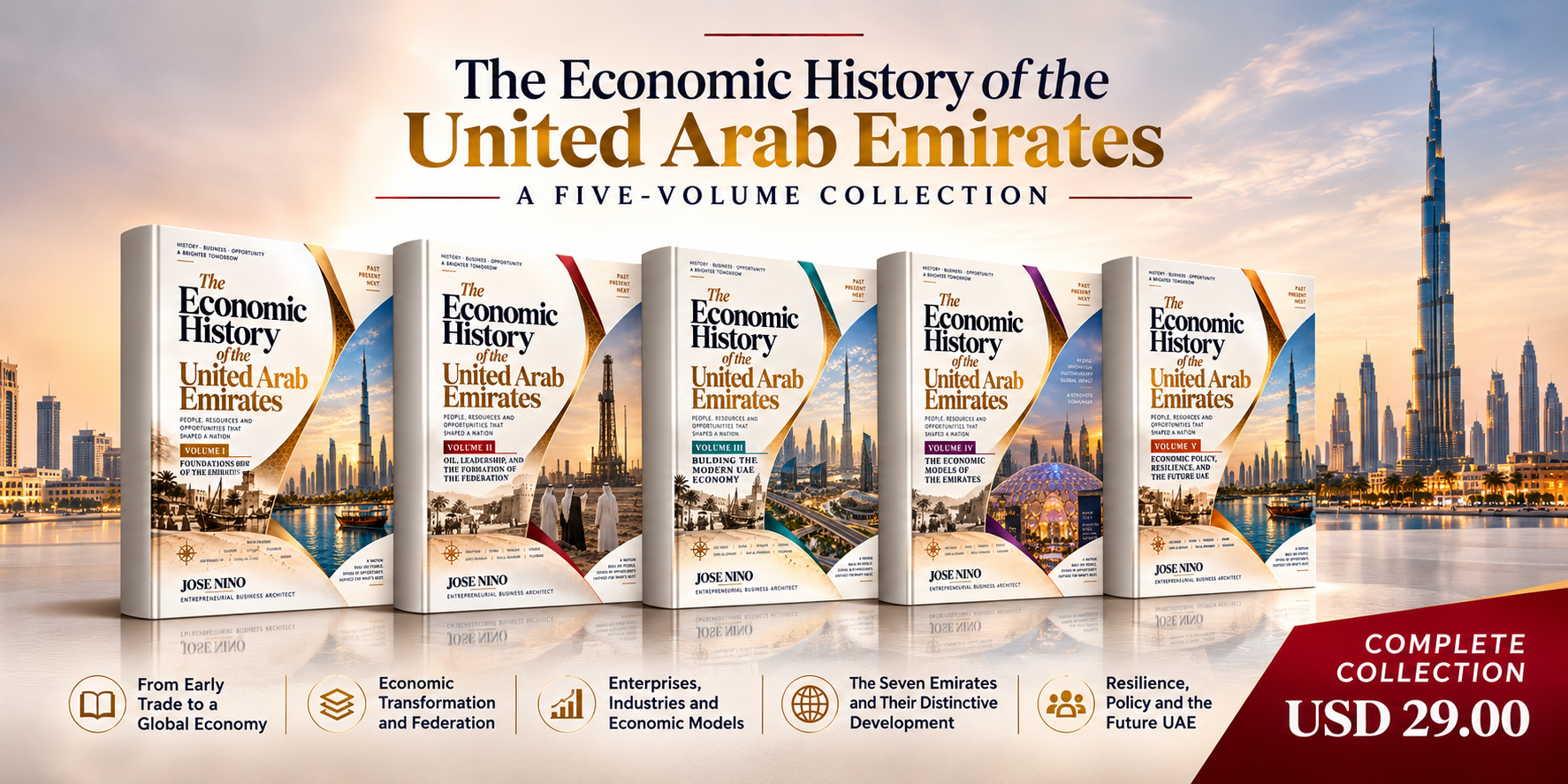
The historical developments examined in this article are explored in greater depth in The Economic History of the United Arab Emirates, a comprehensive five-volume collection by Jose Nino, published through ONE Business.
Volume II, Oil, Leadership, and the Formation of the Federation, examines the discovery and commercialization of petroleum, the economic transformation of Abu Dhabi and Dubai, the political developments leading to federation, and the creation of institutions that supported the emerging national economy.
The collection connects the economic history of the Emirates with broader questions of entrepreneurship, strategic development, institutional capacity, economic resilience, and Entrepreneurial Business Architecture.
Five volumes. Seven emirates. One extraordinary economic transformation. Practical lessons for today's entrepreneurs.
Complete Five-Volume Digital PDF Collection — USD 29.99
Establishing Your Business in the United Arab Emirates
The economic history of the UAE demonstrates that business opportunities must be evaluated within the context of available resources, institutional arrangements, infrastructure, and long-term commercial objectives.
For international entrepreneurs, establishing a business in the UAE requires similar strategic considerations. Selecting an appropriate jurisdiction, understanding licensing requirements, identifying customers, evaluating operating costs, and choosing a suitable legal and commercial structure are essential steps in creating a viable enterprise.
ONE Business Dubai provides UAE company formation and business registration services, assisting entrepreneurs and international businesses with the establishment process according to their proposed activities and applicable requirements.
UAE Company Formation & Business Registration — Professional Fees from USD 1,200 + Government Fees
The final scope and cost depend on the selected jurisdiction, business activity, registration requirements, and additional services requested.
Request UAE Company Formation & Business Registration Assistance
The Entrepreneurial Legacy of the UAE's Oil Discovery
The discovery of oil changed the economic future of the Emirates, but the enduring lesson is not that prosperity depends on finding an extraordinary natural resource. It is that opportunities must be developed through deliberate decisions, sustained investment, effective partnerships, appropriate institutions, and the disciplined organization of productive capabilities.
Entrepreneurs rarely control the economic circumstances into which they enter. They cannot guarantee market demand, technological change, financial conditions, or the behavior of competitors. They can, however, investigate opportunities, establish sound commercial relationships, manage resources responsibly, and design organizations capable of adapting to uncertainty.
The history of petroleum exploration along the Trucial Coast demonstrates how uncertainty can be approached through patient investigation and structured cooperation. The subsequent development of commercial production illustrates how potential value becomes revenue only when the necessary technical and operational systems are established. The broader transformation of the Emirates reveals why financial capacity must ultimately be converted into institutions and productive economic activity.
These principles lie at the center of Entrepreneurial Business Architecture.
The greatest entrepreneurial lesson from the discovery of oil in the UAE is that wealth does not begin with the resource itself. It begins with the capacity to recognize opportunity, organize resources, create productive systems, and transform economic potential into lasting value.
Discover the historical foundations of these transformations in The Economic History of the United Arab Emirates, the complete five-volume collection by Jose Nino.
Discover the Complete Five-Volume Collection — USD 29.99
Contact ONE Business Dubai for UAE Company Formation Services