ONE BUSINESS / INSIGHTS / ARTICLE 10
How the UAE's Four Smaller Emirates Built Competitive Economies: 12 Entrepreneurial Lessons in Specialization
The Entrepreneurial Lessons Behind Economic Specialization, Maritime Trade, Industrial Development, Strategic Geography, Competitive Differentiation, and the Transformation of Ajman, Umm Al Quwain, Fujairah, and Ras Al Khaimah
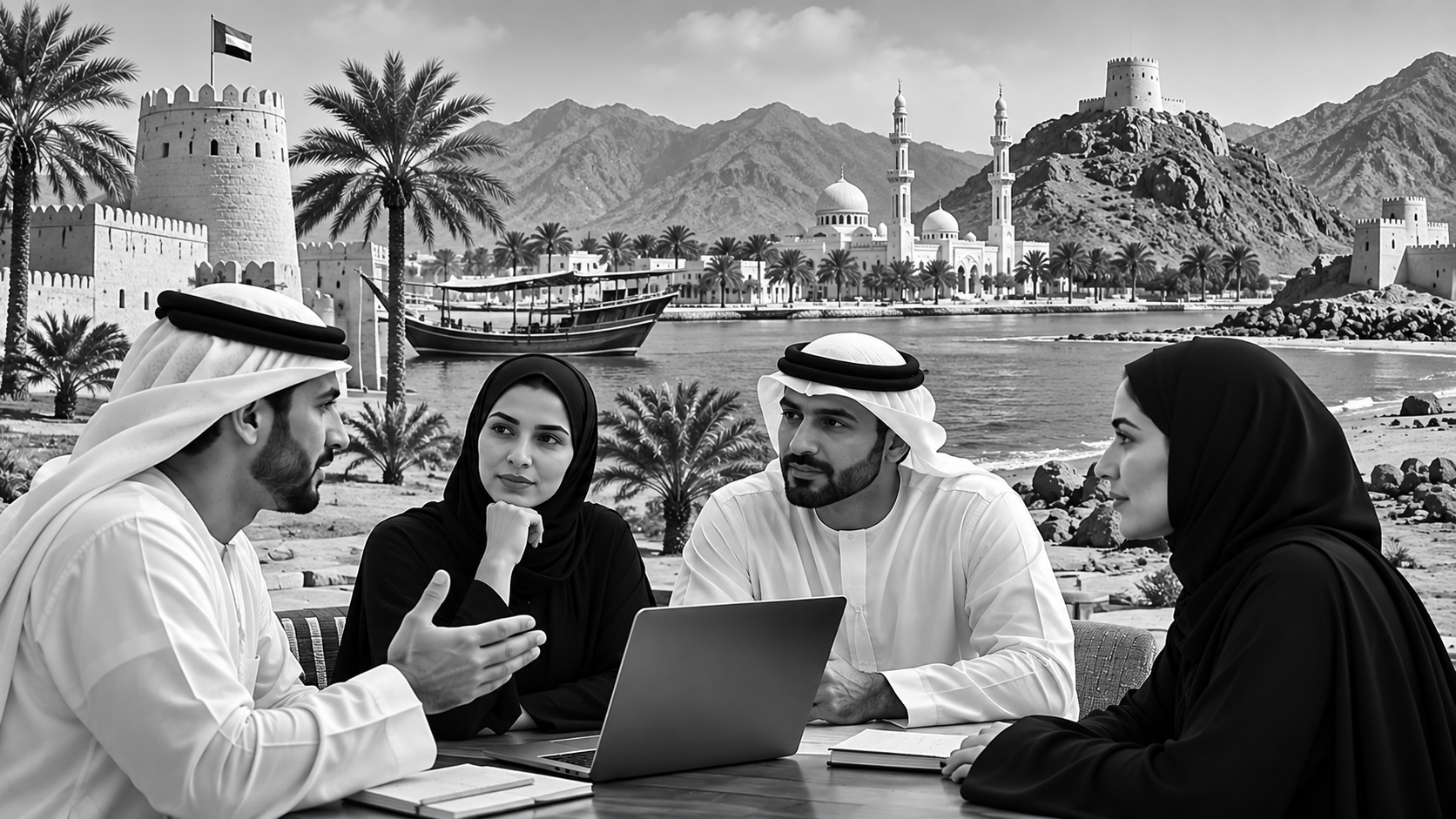
Four Emirates, Four Economic Paths, and One Powerful Lesson in Entrepreneurship
The economic history of the United Arab Emirates is frequently told through the remarkable transformation of Dubai and Abu Dhabi. Dubai's emergence as an international center of trade, finance, transportation, and entrepreneurship, together with Abu Dhabi's development through petroleum resources, strategic investment, and national leadership, provides compelling examples of economic transformation. Yet understanding the UAE requires examining the experiences of all seven emirates, including the four that have historically possessed smaller populations, more limited financial resources, or less international visibility.
Ajman, Umm Al Quwain, Fujairah, and Ras Al Khaimah demonstrate that economic development does not follow a single universal model. Their histories reflect different geographical conditions, productive traditions, commercial relationships, and institutional choices. Each emirate developed economic activities connected to its particular circumstances, and each faced the challenge of converting those activities into opportunities for long-term development.
Before the discovery and commercial exploitation of petroleum transformed the Arabian Gulf, these territories supported economies based on maritime trade, fishing, pearling, boatbuilding, agriculture, livestock, and regional exchange. Their economic activities were shaped by coastal access, available freshwater, agricultural land, mountain geography, and connections with surrounding communities. These resources were distributed unevenly, creating different opportunities and limitations across the four emirates.
Ajman developed maritime and commercial traditions that included fishing, pearling, and dhow building. Umm Al Quwain maintained a coastal economy supported by fishing, maritime activity, and connections with its surrounding environment. Fujairah's location on the Gulf of Oman provided access to maritime routes outside the Strait of Hormuz, while Ras Al Khaimah combined coastal commercial activity with agricultural production, mountain resources, and established trading relationships.
Their subsequent economic development illustrates different approaches to specialization. Ajman expanded manufacturing and commercial activities. Umm Al Quwain pursued opportunities consistent with its scale and local resources. Fujairah developed important maritime, logistics, and energy-related infrastructure. Ras Al Khaimah established significant industrial capabilities, including ceramics, building materials, and manufacturing, alongside tourism and other economic activities.
These transformations were neither identical nor automatic. Each emirate faced limitations involving capital, infrastructure, market access, and competition from larger commercial centers. Their development required identifying productive advantages, creating supporting institutions, attracting investment, and determining which activities could establish a distinctive economic position within the wider UAE.
For contemporary entrepreneurs, these experiences provide an important alternative to the assumption that business success requires the largest market, the greatest financial resources, or the most prominent location. Smaller enterprises can create substantial value when they understand their capabilities, identify specialized opportunities, and design operating models appropriate to their circumstances.
The following twelve entrepreneurial lessons examine the historical development of Ajman, Umm Al Quwain, Fujairah, and Ras Al Khaimah through the perspective of Entrepreneurial Business Architecture (EBA). They explore how specialization, strategic positioning, infrastructure, industrial ecosystems, financial discipline, and institutional development can help smaller economies and enterprises construct sustainable competitive advantages.
1. Entrepreneurial Lesson: Economic Success Does Not Require Being the Largest Competitor
The four smaller emirates demonstrate that economic significance cannot be measured exclusively through population, geographical size, or financial resources. Although Dubai and Abu Dhabi developed internationally prominent economic models, Ajman, Umm Al Quwain, Fujairah, and Ras Al Khaimah possessed productive capabilities that contributed to the wider regional economy.
Their historical activities reflected the resources available within their territories. Coastal settlements supported fishing, pearling, and maritime commerce. Agricultural communities developed around suitable land and water resources. Mountain environments provided materials and influenced transportation and settlement patterns. Each territory participated in economic activities according to its circumstances rather than attempting to reproduce every characteristic of neighboring settlements.
This diversity became increasingly important as the UAE developed. The economic opportunities available to a coastal industrial center differed from those associated with an agricultural region, a deep-water port, or a territory possessing mineral resources suitable for construction materials.
Entrepreneurs frequently encounter similar differences in competitive scale. A small company may operate in a market dominated by organizations with substantially greater financial resources, extensive distribution networks, and established brands. Attempting to compete with these organizations across every dimension can create unsustainable financial and operational demands.
A more productive strategy begins by identifying the customers, services, or activities for which the smaller enterprise can develop a distinctive advantage. A specialized manufacturer may serve a particular industrial requirement more effectively than a diversified competitor. A professional services firm may establish expertise in a narrow regulatory or commercial field. A regional distributor may understand local customers more thoroughly than a larger organization.
The strategic objective is not to imitate the scale of the largest competitor. It is to develop an economic proposition that customers value and that the enterprise can deliver profitably.
The first entrepreneurial lesson is that smaller organizations can build competitive economies and successful businesses when they concentrate on creating distinctive value rather than attempting to reproduce the scale of larger competitors.
2. Entrepreneurial Lesson: Specialization Begins with Understanding Available Resources and Capabilities
The traditional economies of the four emirates developed through close relationships with their natural environments. Coastal access supported maritime activities, while agricultural production depended on the availability of water, suitable soil, and accumulated knowledge of local conditions. These differences influenced how communities organized production and exchange.
Ras Al Khaimah, for example, possessed agricultural areas and mountain resources that distinguished its economic environment from those of smaller coastal settlements. Fujairah's eastern location created a different maritime position from emirates situated primarily along the Arabian Gulf. Ajman's coastal communities developed maritime skills and commercial relationships associated with fishing, pearling, and vessel construction.
These characteristics did not automatically determine future prosperity, but they provided foundations upon which productive capabilities could develop. Economic specialization emerged from the interaction between available resources, accumulated expertise, market opportunities, and the decisions of local communities and institutions.
Entrepreneurs should begin with a comparable assessment of their own capabilities. Before selecting a market opportunity, founders need to understand which resources they possess, what their organization can perform effectively, and which limitations must be addressed.
Such an assessment should extend beyond financial capital. Technical knowledge, professional experience, supplier relationships, access to customers, geographical position, intellectual property, and operational expertise may represent important sources of competitive advantage.
The challenge is to distinguish resources that merely exist from capabilities that can be organized into a viable commercial proposition. Possessing specialized knowledge does not guarantee that customers will pay for it. Access to a market does not guarantee that an enterprise can serve that market profitably.
The second entrepreneurial lesson is that effective specialization begins with an honest evaluation of available resources and capabilities, followed by the development of a business model that converts those strengths into customer value.
3. Entrepreneurial Lesson: Traditional Industries Can Provide the Foundations for New Economic Activities
Ajman's historical maritime economy illustrates how traditional productive activities can contribute to later economic development. Fishing, pearling, boatbuilding, and regional commerce required technical knowledge, practical skills, commercial relationships, and the ability to organize labor and resources.
Dhow building represented an especially important example of specialized production. Constructing traditional wooden vessels required knowledge of materials, design, craftsmanship, and maritime requirements. These capabilities supported transportation, fishing, and trading activities within the regional economy.
Although the economic importance of traditional pearling declined during the twentieth century, the broader experience of maritime production and commerce remained part of Ajman's economic foundation. The emirate subsequently developed manufacturing, commercial activities, and industrial infrastructure that contributed to a more diversified economy.
The historical relationship between traditional industries and modern economic development should not be interpreted as an automatic progression. Specialized skills may become less commercially relevant when technology changes, and new industries often require capabilities that differ substantially from those of earlier activities.
Nevertheless, accumulated knowledge can provide a useful starting point for identifying opportunities. An enterprise operating in a traditional sector may possess relationships, customer understanding, technical experience, or distribution capabilities that can support related products and services.
A small manufacturer may expand into specialized components using its existing production knowledge. A family trading company may develop distribution services for related industries. A traditional service provider may introduce modern technology while retaining the customer relationships and professional expertise that originally supported its business.
The third entrepreneurial lesson is that traditional economic activities can become foundations for new opportunities when entrepreneurs identify which accumulated capabilities remain valuable and adapt them to changing market requirements.
4. Entrepreneurial Lesson: Financial Discipline Is Essential When Resources Are Limited
Umm Al Quwain's historical economy demonstrates the importance of adapting productive activities to a relatively limited resource base. Fishing, maritime commerce, and other local activities supported communities whose economic possibilities were shaped by geography, environmental conditions, and access to regional markets.
Unlike an economy capable of financing extensive development through substantial petroleum revenues, a smaller economy must give particular attention to the relationship between investment requirements and expected productive benefits. Infrastructure, public services, and commercial initiatives compete for financial resources that cannot support every possible project simultaneously.
This creates a fundamental strategic challenge: how can limited resources be allocated to activities that offer the greatest potential contribution to long-term economic development?
Entrepreneurs encounter this problem throughout the life of an enterprise. A founder may identify several attractive opportunities but possess sufficient capital to pursue only one or two. Expanding too rapidly can create cash-flow difficulties, operational weaknesses, and financial commitments that exceed the company's capacity.
Financial discipline requires distinguishing essential investments from discretionary expenditure. Entrepreneurs should evaluate the commercial purpose of each major commitment, the timing of expected returns, the possibility of delays, and the consequences if projected revenue does not materialize.
Limited resources can also encourage cooperation. Shared facilities, outsourced services, partnerships, and specialized suppliers may allow smaller enterprises to access capabilities without assuming the full cost of developing them internally.
The objective is not simply to minimize expenditure. Excessive cost reduction can weaken the business if it prevents investment in essential systems, customer service, or productive capabilities. The objective is to allocate capital according to clearly defined economic priorities.
The fourth entrepreneurial lesson is that resource limitations make strategic financial discipline especially important, requiring entrepreneurs to concentrate investment on capabilities that directly support commercial viability and long-term value creation.
5. Entrepreneurial Lesson: Strategic Geography Can Create Specialized International Opportunities
Fujairah occupies a distinctive position within the United Arab Emirates because its principal coastline faces the Gulf of Oman rather than the Arabian Gulf. This geographical characteristic connects the emirate directly with maritime routes leading toward the Indian Ocean.
The importance of this position becomes especially clear when considering the Strait of Hormuz. Vessels traveling to ports within the Arabian Gulf must generally pass through this strategically significant waterway. Fujairah's location outside the strait provides a different logistical position, creating opportunities for maritime services, storage facilities, and international shipping activities.
However, geographical advantages do not automatically produce commercial success. A favorable coastal position must be supported by appropriate port facilities, transportation infrastructure, operational services, investment, and institutional arrangements that allow businesses to use it effectively.
Fujairah's development illustrates how a distinctive location can become the foundation of an economic specialization when supporting capabilities are established. Its maritime infrastructure and energy-related logistics activities have contributed to its position within regional and international transportation networks.
For entrepreneurs, this history demonstrates the importance of identifying advantages that are not easily reproduced by competitors. A company's geographical position may provide access to particular customers, transportation routes, natural resources, or specialized commercial environments.
Nevertheless, founders must examine whether these advantages correspond to actual market demand. A strategic location that does not support the proposed business model may offer little practical value. The commercial opportunity emerges when geographical characteristics, operational capabilities, and customer requirements are aligned.
The fifth entrepreneurial lesson is that strategic geography becomes a defensible competitive advantage when entrepreneurs develop the infrastructure, relationships, and services required to convert location into commercial value.
6. Entrepreneurial Lesson: Infrastructure Can Transform a Local Advantage into an International Business
The development of the Port of Fujairah demonstrates how infrastructure investment can expand the economic possibilities associated with a geographical advantage. The port began operations in the early 1980s and subsequently became an important component of the emirate's maritime and logistics economy.
Fujairah's position on the Gulf of Oman created opportunities for commercial shipping, while investment in port facilities and supporting infrastructure allowed those opportunities to develop into organized economic activities. The expansion of oil storage, bunkering, and related maritime services contributed to the emirate's specialization within international energy and transportation networks.
The relationship between infrastructure and economic activity is reciprocal. Commercial demand can justify investment in additional facilities, while improved infrastructure can attract new customers and support related businesses. Over time, these interactions may contribute to the development of a specialized economic ecosystem.
Entrepreneurs face similar decisions when determining whether to invest in productive infrastructure. A company may need warehousing, manufacturing equipment, information systems, transportation capabilities, or specialized facilities to serve a growing market.
The appropriate investment depends on expected demand, operating requirements, financing capacity, and the availability of alternative arrangements. Ownership of infrastructure is not always necessary. Leasing facilities, contracting specialized providers, or entering strategic partnerships may provide access to essential capabilities with lower initial capital requirements.
Infrastructure decisions should therefore be connected to the enterprise's broader business architecture. Physical assets must support a viable commercial proposition, and their costs must remain consistent with the organization's financial model.
The sixth entrepreneurial lesson is that infrastructure creates lasting economic value when it strengthens the ability to serve a clearly identified market and supports the development of complementary commercial activities.
7. Entrepreneurial Lesson: Industrial Specialization Can Create International Competitiveness
Ras Al Khaimah provides an important example of how an emirate can develop industrial capabilities that extend beyond its local market. Its economic environment includes agricultural traditions, coastal commercial activity, mountain resources, and access to materials relevant to construction and manufacturing.
The development of industrial activities created opportunities to transform these resources and capabilities into products serving regional and international customers. The establishment of RAK Ceramics in 1989 became a prominent example of manufacturing specialization associated with Ras Al Khaimah.
The company's subsequent expansion demonstrated the possibilities available to manufacturers that develop production capabilities, commercial distribution, and products capable of competing beyond their original geographical market. Its growth should not be interpreted as evidence that every industrial investment will succeed, but it illustrates the potential of focused manufacturing strategies.
Industrial competitiveness requires more than access to raw materials. Manufacturers must manage production costs, product quality, technology, supply chains, customer requirements, and distribution. A favorable resource base can support an enterprise, but operational competence determines whether that advantage can be converted into sustainable commercial performance.
Entrepreneurs can apply this principle by identifying products or services for which they can develop specialized expertise. Instead of entering numerous unrelated markets, a business may concentrate on a particular industry, improve its operating processes, and gradually expand its customer base.
Specialization can also create opportunities for international expansion. A company that develops a competitive product for a narrow market may eventually serve customers across multiple countries without abandoning its original technical focus.
The seventh entrepreneurial lesson is that international competitiveness can emerge from focused industrial specialization when productive resources are combined with operational excellence, consistent quality, and access to wider markets.
8. Entrepreneurial Lesson: Economic Clusters Strengthen the Capabilities of Individual Enterprises
Industrial development in Ras Al Khaimah and Ajman illustrates the potential benefits of concentrating complementary economic activities within organized commercial environments. Manufacturing enterprises depend on suppliers, transportation providers, technical specialists, administrative services, and infrastructure that support production and distribution.
When these capabilities are available within a relatively concentrated area, businesses may benefit from lower coordination costs, improved access to specialized services, and opportunities for commercial cooperation. Industrial zones and free zones can provide institutional and physical environments intended to support these activities.
Ras Al Khaimah's industrial development and the evolution of its economic-zone arrangements, including the establishment of Ras Al Khaimah Economic Zone (RAKEZ) in 2017, illustrate the role of organized business environments. Ajman's commercial and industrial development has likewise been supported by infrastructure and institutional initiatives, including Ajman Free Zone.
The existence of a business zone does not automatically guarantee the success of companies operating within it. Enterprises still require viable products, effective management, customers, and financial discipline. However, an appropriate commercial environment can reduce certain barriers associated with establishing and operating a business.
Entrepreneurs should therefore evaluate not only the legal or administrative characteristics of a proposed location, but also the wider economic ecosystem. Access to suppliers, skilled employees, transportation infrastructure, customers, and complementary services can influence the total cost and operational feasibility of an enterprise.
A specialized manufacturing company may benefit from operating near industrial suppliers, while a digital services enterprise may prioritize access to professional talent, reliable connectivity, and international customers. The most appropriate ecosystem depends on the organization's actual operating requirements.
The eighth entrepreneurial lesson is that enterprises become more competitive when they operate within ecosystems that provide complementary infrastructure, institutional support, specialized services, and productive commercial relationships.
9. Entrepreneurial Lesson: Diversification Should Build on Existing Economic Strengths
The economic development of the four smaller emirates demonstrates that diversification can follow different paths. Ajman's manufacturing and commercial activities, Fujairah's maritime and energy-related logistics, Ras Al Khaimah's industrial production and tourism, and Umm Al Quwain's developing commercial activities reflect distinct combinations of opportunities and resources.
These differences are important because diversification does not require every economy to develop the same industries. A territory with specialized port infrastructure may identify opportunities in logistics and related services, while an emirate possessing industrial expertise may pursue additional manufacturing activities.
For entrepreneurs, the central question is whether a proposed new activity strengthens the existing organization. Diversification can reduce dependence on a single product or customer group, but it can also introduce additional costs, management complexity, and operational risks.
A manufacturer might diversify into related product categories using established production systems. A logistics provider may develop warehousing, freight coordination, or distribution services. A professional services firm may introduce complementary offerings that address additional needs of its existing customers.
These strategies differ from entering unrelated industries solely because they appear profitable. Without appropriate expertise, market knowledge, and financial capacity, diversification can weaken the enterprise's original competitive position.
Entrepreneurial Business Architecture provides a useful framework for evaluating such decisions. Each proposed activity should be assessed according to its strategic purpose, commercial viability, operating requirements, financial consequences, and relationship with the enterprise's existing capabilities.
The ninth entrepreneurial lesson is that sustainable diversification develops complementary economic activities around established strengths rather than expanding indiscriminately into markets that the organization is not prepared to serve.
10. Entrepreneurial Lesson: Smaller Markets Can Become Platforms for International Expansion
The economic histories of Ajman, Umm Al Quwain, Fujairah, and Ras Al Khaimah demonstrate that the size of a local market does not necessarily determine the geographical reach of an enterprise. Maritime trade historically connected coastal communities with commercial partners beyond their immediate territories, while modern transportation and manufacturing infrastructure expanded opportunities for participation in international markets.
Fujairah's maritime services respond to requirements associated with international shipping. Ras Al Khaimah's manufacturing activities include products serving markets beyond the UAE. These examples illustrate how enterprises located in smaller economies can develop business models directed toward customers across wider geographical regions.
International expansion nevertheless requires more than the ability to produce a competitive product. Businesses must understand foreign customer requirements, transportation costs, contractual arrangements, payment risks, applicable regulations, and the operational implications of serving distant markets.
Entrepreneurs should therefore distinguish between local market size and accessible market opportunity. A company may be established in a relatively small jurisdiction while serving customers throughout a region or internationally. Its economic potential depends on the viability of its distribution channels, the competitiveness of its offering, and its capacity to manage cross-border operations.
Digital technologies have expanded these possibilities for many service-based enterprises. However, international market access still requires effective customer acquisition, reliable delivery, appropriate legal arrangements, and financial management.
A small domestic market can encourage entrepreneurs to develop an international perspective from the beginning, but successful expansion must be supported by evidence of demand and the operational capabilities required to serve that demand consistently.
The tenth entrepreneurial lesson is that a small home market need not limit a company's ambitions when its business model, distribution capabilities, and commercial relationships are designed to serve customers beyond its original geographical boundaries.
11. Entrepreneurial Lesson: Economic Resilience Depends on Adaptation Rather Than Dependence on One Industry
The historical economies of the smaller emirates experienced the consequences of changing regional and international markets. Traditional pearling declined dramatically during the early twentieth century, while technological developments, changing transportation systems, and new patterns of demand altered the commercial significance of established activities.
These changes created difficult conditions for communities whose livelihoods depended on traditional industries. Alternative economic activities did not immediately eliminate hardship, and the capacity to adapt varied according to local resources, institutions, and available opportunities.
The later development of manufacturing, logistics, tourism, commercial services, and specialized industrial activities demonstrates how economic systems can construct additional productive capabilities over time. Diversification can improve resilience when different sectors respond to different market conditions, although no economic structure is completely insulated from external shocks.
Entrepreneurs face similar risks when their organizations depend heavily on a single customer, supplier, product, or distribution channel. Such concentration may initially support efficiency, but it can create substantial vulnerability if commercial conditions change.
Resilience does not require eliminating every concentration risk. Specialized enterprises often depend on a narrow area of expertise. The challenge is to understand the risks associated with that specialization and develop appropriate responses.
These responses may include maintaining financial reserves, developing alternative suppliers, serving multiple customer groups within a specialized market, improving operational flexibility, or introducing complementary products and services.
Entrepreneurs should periodically examine which external changes could threaten the viability of their business models and whether their organizations possess the resources and capabilities necessary to respond.
The eleventh entrepreneurial lesson is that economic resilience emerges from understanding concentration risks, preserving financial and operational flexibility, and developing the capacity to adapt when established markets or industries change.
12. Entrepreneurial Lesson: Competitive Success Requires an Economic Architecture Designed Around Distinctive Strengths
The experiences of Ajman, Umm Al Quwain, Fujairah, and Ras Al Khaimah demonstrate that successful economic development cannot be reduced to a single strategy. Their geographical characteristics, historical industries, productive resources, and institutional arrangements created different opportunities for specialization.
Ajman's maritime traditions and subsequent commercial and industrial activities illustrate the development of productive capabilities within a relatively compact territory. Umm Al Quwain demonstrates the importance of economic priorities and resource allocation in a smaller market. Fujairah's strategic maritime position supports specialized logistics and energy-related services, while Ras Al Khaimah illustrates the potential of industrial production and differentiated economic development.
These examples reveal a broader principle: the appropriate economic architecture depends on the resources, capabilities, markets, and objectives of the organization or territory being developed.
Entrepreneurial Business Architecture applies this principle to the design and development of enterprises. A business requires a clear purpose, a viable value proposition, an identifiable customer market, productive resources, an effective operating model, financial sustainability, appropriate institutional arrangements, and the ability to adapt.
These components must be aligned. A company may possess technical expertise but lack access to customers. It may identify a profitable market but lack the capital necessary to deliver its products. It may establish an attractive business location while failing to develop the commercial relationships required to generate revenue.
Smaller enterprises must be especially disciplined in designing this architecture because they may have fewer resources available to absorb strategic mistakes. Their advantage can emerge from focus, specialization, operational efficiency, and the ability to coordinate limited capabilities around a clearly defined economic purpose.
The histories of the four smaller emirates demonstrate that competitive success does not require identical development models. Economic strength can emerge through different combinations of maritime services, manufacturing, commercial activity, natural resources, institutional development, and strategic specialization.
The twelfth entrepreneurial lesson is that sustainable competitive advantage depends on designing an economic architecture that connects distinctive resources and capabilities with viable markets, productive operations, financial discipline, and a strategy capable of evolving over time.
Explore The Economic History of the United Arab Emirates
The economic histories of Ajman, Umm Al Quwain, Fujairah, and Ras Al Khaimah reveal an essential dimension of the United Arab Emirates' transformation. Their experiences demonstrate that national economic development involves more than the expansion of the largest commercial centers or the exploitation of petroleum resources. It also depends on the productive capabilities, geographical advantages, commercial relationships, and institutional choices developed across different territories.
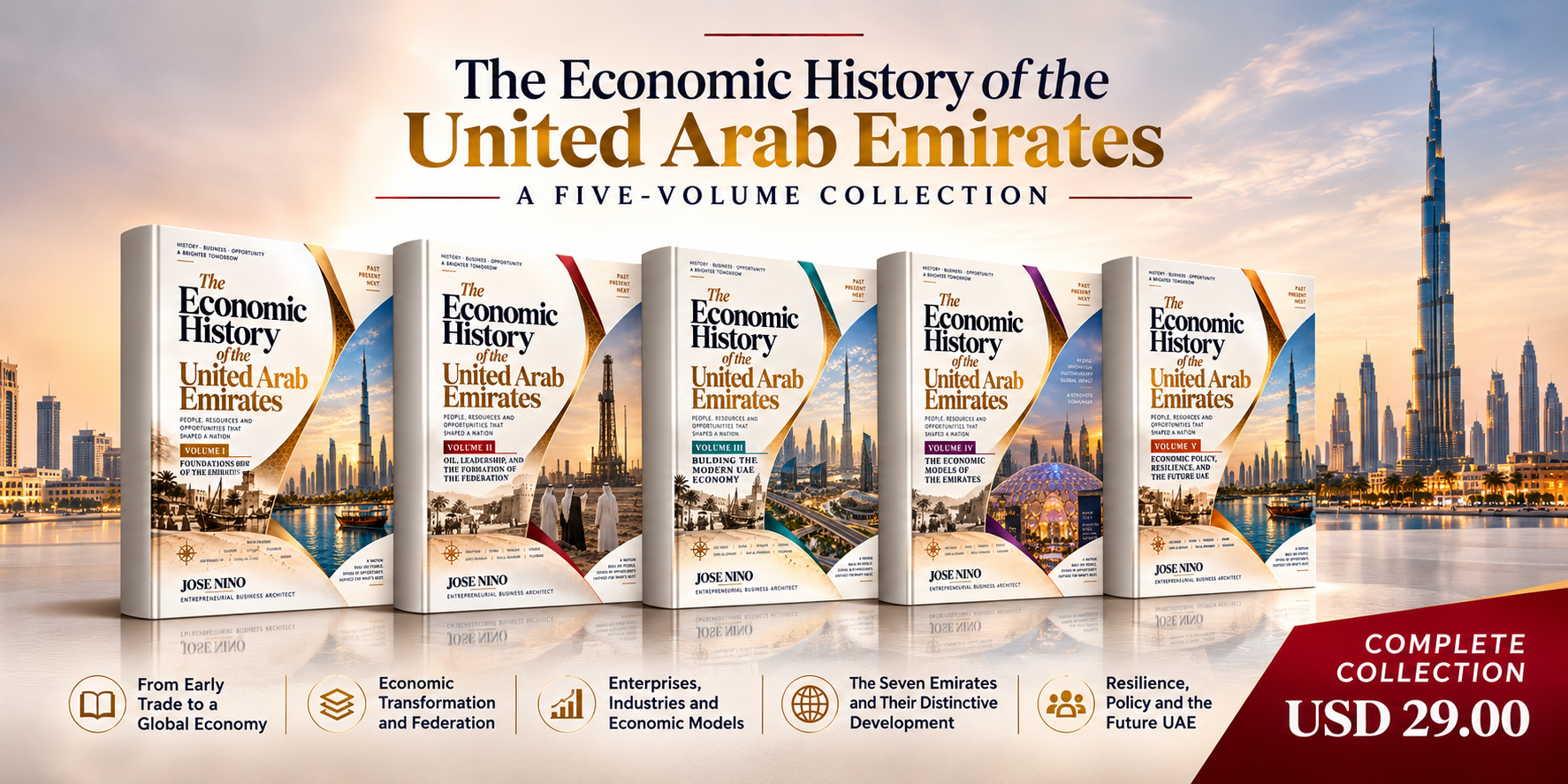
The Economic History of the United Arab Emirates, by Jose Nino, examines these developments through a comprehensive five-volume collection. Volume I, Foundations of the Emirates, explores the historical foundations of the seven emirates, including their traditional economies, commercial networks, political institutions, and economic development before and after the emergence of petroleum.
The collection provides a broader understanding of how the UAE evolved from a group of territories with different economic environments into a federation capable of supporting diversified commercial and industrial activities. It examines the interaction of leadership, resources, institutions, infrastructure, entrepreneurship, and strategic economic development.
For entrepreneurs, investors, researchers, and business professionals, these historical experiences provide valuable perspectives on competitive strategy, specialization, financial discipline, economic resilience, and the organization of productive capabilities.
Five volumes. Seven emirates. One extraordinary economic transformation. Practical lessons for today's entrepreneurs.
Complete Five-Volume Digital PDF Collection — USD 29.99
From Economic Specialization to Establishing Your Business in the UAE
The historical development of the four smaller emirates demonstrates that successful economic participation requires a clear understanding of market opportunities, available resources, infrastructure, institutional arrangements, and competitive positioning. These considerations remain relevant for international entrepreneurs seeking to establish a business in the United Arab Emirates.
The UAE offers different commercial jurisdictions and business environments, each with distinct characteristics. Entrepreneurs considering company formation should evaluate the nature of their proposed activities, target customers, licensing requirements, operational needs, geographical preferences, and financial resources before selecting an establishment structure.
The appropriate jurisdiction is not necessarily the largest or most internationally recognized. A manufacturing enterprise may prioritize access to industrial infrastructure, while a trading company may focus on logistics and distribution. A professional services business may require different facilities, licensing arrangements, and commercial connections.
ONE Business Dubai supports entrepreneurs and international businesses seeking to establish their commercial presence in the United Arab Emirates. Our company formation and business registration services assist clients with the initial establishment process according to their proposed business activities and applicable requirements.
UAE Company Formation & Business Registration — Professional Fees from USD 1,200 + Government Fees
The final scope and estimated cost depend on the proposed activity, selected jurisdiction, registration requirements, and additional services requested. Entrepreneurs considering business establishment in Dubai, Ajman, Umm Al Quwain, Fujairah, Ras Al Khaimah, or elsewhere in the UAE can contact our team to discuss their objectives and request a tailored quotation.
Request UAE Company Formation & Business Registration Assistance
Build a Competitive Enterprise Through Specialization
The economic history of the UAE's four smaller emirates provides an important lesson for entrepreneurs operating in competitive markets. Economic success does not necessarily belong to the largest organization, the wealthiest territory, or the enterprise with the broadest range of activities. It can emerge from the disciplined development of specialized capabilities that meet identifiable market needs.
Ajman, Umm Al Quwain, Fujairah, and Ras Al Khaimah demonstrate that different resources and geographical conditions can support different economic models. Their experiences encourage entrepreneurs to examine their own circumstances carefully rather than imitate strategies developed for organizations with fundamentally different capabilities.
For contemporary founders, these principles translate into practical responsibilities. Identify a viable market, understand the resources available, develop a differentiated value proposition, invest in essential operating capabilities, maintain financial discipline, and establish commercial relationships that support long-term growth.
These are central principles of Entrepreneurial Business Architecture. A sustainable enterprise is not created by accumulating unrelated activities or pursuing expansion without direction. It is developed by connecting resources, capabilities, customers, operations, and financial arrangements around a coherent economic purpose.
The greatest entrepreneurial lesson from the UAE's four smaller emirates is that competitive advantage does not depend on being the biggest. It depends on understanding what makes an economy or enterprise distinctive and building the capabilities required to transform that distinction into lasting economic value.
Discover the historical foundations of these transformations in The Economic History of the United Arab Emirates, the complete five-volume collection by Jose Nino.
Discover the Complete Five-Volume Collection — USD 29.99
Contact ONE Business Dubai for UAE Company Formation Services