ONE BUSINESS / INSIGHTS / ARTICLE 04
How Visionary Leadership Built the Foundations of the UAE Economy
The Entrepreneurial Lessons Behind Building Institutions, Creating Stability, and Developing Businesses That Last

Every entrepreneur who arrives in Dubai encounters the visible achievements of an economy that has developed extraordinary commercial capabilities. International airports connect businesses with distant markets, ports support global trade, specialized commercial districts bring enterprises together, and institutions provide the frameworks within which thousands of companies establish their operations. These achievements can create the impression that economic development follows naturally when a territory possesses a favorable location, financial resources, and access to international markets. Yet history demonstrates that resources and opportunities, however valuable, do not automatically produce successful economies. They must be recognized, organized, protected, and transformed into productive capabilities through decisions made by individuals and institutions.
The historical development of the United Arab Emirates provides a particularly valuable perspective on this relationship between opportunity and leadership. Long before the federation was established in 1971, the territories that would become the seven emirates were governed through distinct political arrangements, commercial relationships, tribal structures, and local institutions. Their ruling families confronted different combinations of geographical limitations, economic opportunities, social responsibilities, commercial interests, and external pressures. The decisions made within these circumstances contributed to the formation of political and economic environments that would influence the country's subsequent development.
For entrepreneurs, this history introduces a fundamental question: Why do some founders transform an opportunity into a durable organization while others remain dependent upon their personal efforts, temporary advantages, or favorable circumstances? The answer cannot be reduced to vision alone. Leadership must be translated into organizational arrangements, relationships, resource allocation, operational capabilities, and decisions that allow productive activity to continue over time. This distinction is equally relevant when building a commercial enterprise, developing an institution, or understanding the economic foundations of a country.
The historical experiences of the Al Nahyan family in Abu Dhabi, the Al Maktoum family in Dubai, the Al Qasimi in Sharjah and Ras Al Khaimah, and the ruling houses of the other emirates reveal different approaches to the challenges of leadership and institutional continuity. These histories should not be interpreted as identical examples of modern entrepreneurship. Political leadership and private enterprise operate under different forms of authority, accountability, and responsibility. Nevertheless, the economic mechanisms through which leaders coordinate resources, establish credibility, support commercial activity, and develop durable institutions offer important lessons for contemporary business founders.
This article explores those mechanisms through an entrepreneurial perspective. Its purpose is not to turn political history into a simplified business success story, but to examine how leadership influences the development of economic capabilities and why the quality of organizational decisions matters when entrepreneurs seek to create businesses capable of surviving beyond their initial establishment.
1. The First Leadership Lesson: Opportunity Does Not Organize Itself
An economic opportunity can exist for generations without producing its full potential. A coastline may provide access to trading routes, but commercial development requires vessels, merchants, facilities, relationships, and arrangements that make exchange possible. An oasis may offer water and agricultural possibilities, but sustainable economic activity depends upon access, labor, cooperation, and the organization of production. The existence of an advantage therefore represents only one element of development. The decisive challenge is converting an available possibility into a functioning economic system.
The early political and economic history of the Emirates demonstrates the importance of this transformation. Communities operated within environments where authority, commercial exchange, resource access, and social relationships were closely connected. Leadership involved navigating competing interests and maintaining arrangements through which people could conduct their activities. Different ruling families faced different circumstances, and their historical development cannot be explained by a single uniform model.
This is an essential lesson for modern entrepreneurs because business opportunities frequently appear more complete than they actually are. A founder may identify strong demand for a service, discover an attractive international market, or recognize a product that could be distributed through Dubai. Yet none of these observations automatically creates an enterprise. Customers must be reached, transactions organized, suppliers coordinated, financial resources allocated, and operational responsibilities established. Without these elements, an opportunity remains a possibility rather than an operating business.
Entrepreneurial leadership begins when the founder accepts responsibility for organizing those elements. The business idea may provide direction, but execution requires a system of decisions and activities that can produce results consistently. A successful founder does not merely recognize what could exist; the founder develops the organization capable of making it exist. This distinction separates entrepreneurial ambition from enterprise construction and provides the foundation for understanding leadership as a productive economic capability.
2. The Al Nahyan: Leadership, Resources, and the Development of Abu Dhabi
The historical development of Abu Dhabi reflects the interaction between political authority, access to resources, community relationships, and changing economic conditions. The Al Nahyan emerged within the Bani Yas tribal confederation, and Abu Dhabi's early development was connected to the wider regional economy, including oasis agriculture, maritime activities, and pearling. These activities supported livelihoods in a demanding environment, but they did not provide the scale of financial resources that would become available during the petroleum era.
The importance of this history lies in recognizing that the political and economic foundations of Abu Dhabi existed before oil. Leadership operated within a setting where resources were limited and where maintaining relationships among communities and economic participants was essential. The later transformation associated with petroleum created opportunities of an entirely different magnitude, but the ability to direct those resources toward development required institutional decisions, public investment, and the organization of economic priorities.
Sheikh Zayed bin Sultan Al Nahyan became central to this transformation through his leadership of Abu Dhabi and subsequently as the founding President of the United Arab Emirates. His historical significance extends beyond the availability of petroleum revenues. The development of infrastructure, public services, institutions, and the federation required decisions about how resources should be used and how the benefits of development could support a broader economic and social transformation.
For entrepreneurs, the relevant principle is the difference between possessing resources and converting those resources into productive capabilities. A company may obtain investment capital, generate substantial initial revenue, or gain access to a valuable market. These achievements create opportunities, but they do not guarantee sustainable development. Capital can be consumed without building operational strength, and revenue can increase without improving the enterprise's capacity to serve customers reliably.
A founder must therefore decide how available resources will contribute to the future capabilities of the business. Investments in skilled personnel, technology, operating processes, customer relationships, and financial resilience may strengthen an enterprise beyond its immediate sales performance. The lesson is not that every company should follow the development priorities of a government, but that leadership becomes economically meaningful when resources are transformed into capabilities that remain valuable over time.
3. The Al Maktoum: Commercial Leadership and Dubai's Development
Dubai's economic trajectory offers a different perspective on leadership because the city's historical development became closely associated with commerce, maritime exchange, and relationships with merchant communities. The Al Maktoum dynasty was established in Dubai in 1833, and the city's subsequent history involved decisions concerning political authority, commercial conditions, and the development of a trading economy.
Dubai's commercial orientation did not emerge from a single decision or from the actions of one leader. Its development reflected geography, regional trading relationships, merchant activity, competition, infrastructure, and changing political and economic circumstances. Nevertheless, the relationship between leadership and the commercial environment became an important element of the city's economic history. Decisions that affected the conditions under which merchants could operate influenced the attractiveness of Dubai as a place for trade and settlement.
This relationship introduces a particularly important entrepreneurial principle: leaders can create value not only through the activities they perform directly, but also through the conditions they establish for others to become productive. In a business organization, this may involve developing clear processes, enabling employees to make appropriate decisions, improving coordination among departments, and creating reliable arrangements with suppliers and customers.
Many founders unintentionally restrict the development of their enterprises by attempting to control every commercial decision personally. During the earliest stages of a business, this approach may appear efficient because the founder possesses most of the relevant knowledge and relationships. As the organization expands, however, excessive dependence on one individual can create delays, reduce responsiveness, and prevent the development of specialized capabilities.
The history of Dubai's commercial development encourages a different way of thinking about leadership. The entrepreneur should ask how the organization can become more productive through the capabilities of its participants rather than relying exclusively on the founder's individual effort. A business becomes stronger when leadership develops an environment in which people, relationships, and operating systems can create value consistently.
4. The Al Qasimi: Maritime Power, Competition, and Strategic Positioning
The Al Qasimi played an important role in the maritime and political history of the Gulf, particularly in the territories associated with Sharjah and Ras Al Khaimah. Their influence developed within a regional environment shaped by maritime commerce, political competition, external powers, and changing commercial conditions. The historical record surrounding Gulf maritime activity is complex, and interpretations of conflict and authority have sometimes been influenced by the perspectives of competing participants.
For economic analysis, the important point is that maritime activity represented more than transportation. Access to vessels, coastal settlements, trading relationships, and strategically significant routes could contribute to economic and political influence. However, maintaining such influence required organizational capabilities and the capacity to respond to competition and external pressures.
This historical experience offers a useful distinction between market access and strategic position. A business may operate within a growing industry without possessing a durable advantage. It may have customers, suppliers, and a recognizable brand, yet remain vulnerable when competitors introduce better services, when market conditions change, or when an important commercial relationship becomes unavailable.
Strategic positioning requires the entrepreneur to understand what makes the enterprise valuable relative to alternatives available to customers. That value might arise from specialized expertise, reliable delivery, differentiated products, stronger customer relationships, or a business model that addresses a specific requirement more effectively than competitors. It must also be supported by capabilities that the organization can sustain.
The lesson is not that commercial enterprises should imitate historical political or military competition. Rather, the history of maritime influence demonstrates that access to a valuable economic environment must be supported by capabilities, relationships, and adaptation if it is to remain meaningful. Entrepreneurs entering the UAE should therefore evaluate not only the opportunities available in their chosen industry, but also the conditions that will determine whether their company can maintain a competitive position.
5. Different Emirates, Different Leadership Decisions
One of the most important characteristics of the UAE's economic history is that its seven emirates did not develop through identical combinations of resources, commercial activities, or institutional arrangements. Dubai, Abu Dhabi, Sharjah, Ras Al Khaimah, Ajman, Umm Al Quwain, and Fujairah possessed different geographical characteristics and followed distinct historical trajectories. Their ruling families operated within those circumstances, making decisions influenced by local opportunities and constraints.
This diversity challenges the assumption that successful development can be reduced to a single formula. A strategy that responds effectively to the conditions of a maritime trading settlement may not be equally appropriate for an oasis economy or a territory whose commercial opportunities depend on different geographical characteristics. Leadership must therefore be understood in relation to the actual environment in which decisions are made.
The same principle applies to entrepreneurship. Business founders frequently study successful companies and attempt to reproduce their organizational structures, marketing strategies, pricing models, or growth methods. Such comparisons can be educational, but they become misleading when differences in customers, capital, capabilities, regulations, and market conditions are ignored.
An entrepreneur establishing a professional services company in Dubai may face different requirements from a founder developing a manufacturing operation in another emirate. The former may depend primarily on expertise, client acquisition, and service delivery, while the latter may require industrial facilities, equipment, supply-chain arrangements, and more substantial operating capital. The appropriate business architecture depends upon the enterprise's actual economic requirements rather than the popularity of a particular commercial model.
The historical diversity of the Emirates therefore reinforces an important lesson: effective leadership is contextual. It requires understanding the resources available, the constraints that must be addressed, the relationships that support productive activity, and the opportunities that can realistically be developed.
6. Institutions Allow Organizations to Survive Beyond Their Founders
One of the most important distinctions between a temporary commercial activity and a durable enterprise is the development of institutions. In economic history, institutions include arrangements, practices, and systems that help coordinate behavior and establish expectations. In modern companies, organizational institutions may take the form of defined responsibilities, operating procedures, governance arrangements, contractual practices, financial controls, and mechanisms for transferring knowledge.
The historical formation of the Emirates involved political structures that developed over time through leadership, relationships, negotiation, and changing conditions. These institutions were not identical to contemporary corporate governance, and their development should not be treated as a direct blueprint for business management. Nevertheless, the broader economic mechanism is relevant: organizations become more durable when important activities are supported by arrangements that do not depend entirely upon one individual's immediate presence.
Many small businesses remain vulnerable because the founder personally controls customer relationships, operational knowledge, supplier arrangements, financial decisions, and service delivery. This concentration may be manageable during the earliest stage, but it creates a serious limitation when the business attempts to expand. Employees cannot perform effectively without access to necessary information, customers may experience inconsistent service, and the founder may become the principal constraint on organizational development.
Institutional development within a company begins by identifying which activities must become repeatable. Customer inquiries should be handled through clear procedures, commitments should be documented, financial information should be available for responsible decision-making, and essential knowledge should be retained within the organization. As the company grows, these arrangements allow responsibilities to be distributed while maintaining accountability.
The entrepreneurial objective is to build a business that can operate as an organization rather than merely as an extension of its founder. This does not require excessive bureaucracy. It requires sufficient structure to preserve reliability, coordinate people, and support continued productive activity.
7. Credibility Is a Foundation of Economic Leadership
Leadership requires more than formal authority. Individuals and organizations must also develop credibility among the people whose cooperation is necessary for productive activity. In historical political systems, legitimacy and authority were shaped by relationships, customary arrangements, community expectations, and the ability to maintain order under changing circumstances. These relationships were complex and cannot be reduced to modern commercial ideas about customer satisfaction or brand reputation.
Nevertheless, an important economic principle emerges from the relationship between leadership and cooperation. When participants believe that an organization will behave predictably and fulfill its commitments, coordination may become easier. When confidence is weak, transactions and relationships may require greater effort, additional safeguards, or more intensive oversight.
For entrepreneurs, credibility develops through conduct that customers, employees, suppliers, and commercial partners can observe. A company that communicates clearly, honors agreed conditions, handles payments responsibly, and addresses problems professionally creates evidence that supports future confidence. Such behavior can improve the quality of commercial relationships, although it cannot eliminate contractual risks or guarantee loyalty.
Credibility also depends on the consistency between what a business promises and what it can actually deliver. Entrepreneurs sometimes attempt to accelerate growth through ambitious claims about capabilities, delivery times, market access, or expected outcomes. If those claims exceed the organization's actual capacity, the resulting failures can weaken relationships that took considerable time to develop.
Sustainable leadership requires aligning commitments with capabilities. The founder should treat reputation as an operational responsibility supported by appropriate processes, not simply as a marketing objective. This principle is especially important for international businesses serving customers across jurisdictions, where commercial confidence may depend heavily on documented performance and transparent communication.
8. Resource Allocation Is One of the Most Important Leadership Decisions
Entrepreneurial leadership is often associated with identifying opportunities and inspiring others, but one of its most consequential functions is determining how limited resources will be used. Every organization faces constraints involving money, time, people, knowledge, and management attention. A founder who commits these resources to one activity reduces their availability for alternative purposes. Resource allocation is therefore inseparable from business strategy.
The historical development of the Emirates illustrates the importance of this principle at an economic level. Different territories possessed different combinations of resources and opportunities, while later periods introduced new possibilities through petroleum revenues, infrastructure investment, and institutional development. The economic consequences of these developments depended partly on decisions about priorities and the organization of available resources.
In a modern enterprise, founders encounter similar allocation problems on a smaller and fundamentally different scale. A company may have sufficient capital to establish operations but insufficient resources to pursue every possible market simultaneously. It may need to choose between expanding its product range, improving existing services, investing in marketing, hiring specialized personnel, or developing more reliable operating systems.
The appropriate decision depends on the enterprise's stage of development and its most significant constraints. A business without validated customer demand may benefit more from market research and commercial testing than from substantial investment in permanent facilities. A company with growing sales but inconsistent service delivery may need stronger operational capabilities before increasing its promotional expenditure. An enterprise with excessive customer concentration may need to develop additional market relationships rather than expand its dependence on the same revenue source.
Good resource allocation connects immediate expenditure with the development of capabilities that improve the company's future performance. Entrepreneurs should therefore evaluate investments according to their contribution to the business model, their financial implications, and the risks associated with the commitments they create.
9. Leadership Requires Adaptation Without Losing Strategic Direction
Economic environments change. Customer requirements evolve, competitors enter markets, technologies alter established practices, and external events can disrupt commercial relationships. Historical leaders confronted changing circumstances through political, economic, and institutional decisions, while modern entrepreneurs face their own forms of uncertainty within competitive markets.
The development of the Emirates was not a continuous sequence of uninterrupted economic progress. Different communities experienced changing commercial conditions, including the vulnerability of maritime activities and the decline of traditional pearling. Later transformations created new opportunities, but these opportunities required new forms of organization and investment. The broader historical pattern demonstrates that established economic activities do not remain viable simply because they have been important in the past.
Entrepreneurs must distinguish between strategic purpose and the specific methods used to pursue it. A company's purpose may be to serve a particular customer need, but the products, technologies, distribution channels, and operating arrangements through which that need is addressed may change. Excessive attachment to an original business model can prevent the organization from responding when better alternatives become available.
Adaptation does not mean changing direction whenever difficulties arise. Constantly abandoning strategies can create confusion, waste resources, and prevent the development of expertise. Effective leadership requires evaluating evidence, distinguishing temporary problems from structural changes, and deciding when the organization should preserve its existing approach or develop new capabilities.
The strongest entrepreneurial organizations combine continuity of purpose with flexibility in execution. They understand what value they intend to create while remaining willing to modify how that value is delivered when market conditions justify change.
10. Entrepreneurial Business Architecture: From Founder Vision to Organizational Capability
Entrepreneurial Business Architecture (EBA) offers a contemporary analytical perspective for understanding how founders can translate opportunities into structured enterprises. Applied to the lessons discussed in this article, EBA emphasizes the relationship between entrepreneurial vision, market requirements, organizational capabilities, commercial relationships, resource allocation, and the systems through which a business creates value.
The first architectural challenge is defining the enterprise's purpose in economically meaningful terms. A founder may want to establish an international company in Dubai, but that ambition must be translated into a clear understanding of the customers the business intends to serve and the value it will provide. Without this definition, organizational decisions may become disconnected from actual commercial requirements.
The second challenge is identifying the capabilities necessary to fulfill that purpose. These may include specialized expertise, supplier relationships, financial resources, technology, customer acquisition, regulatory compliance, and service delivery. The founder must determine which capabilities are essential, how they will be developed or obtained, and how their performance will be evaluated.
The third challenge is organizational coordination. Individual capabilities do not automatically form an effective enterprise. Employees, systems, suppliers, and commercial partners must operate through arrangements that allow their contributions to support a common business model. This requires appropriate responsibilities, communication practices, financial controls, and mechanisms for maintaining service quality.
The fourth challenge is organizational continuity. A business that depends exclusively on the founder's personal involvement may be commercially active but institutionally fragile. EBA encourages founders to consider how essential knowledge, processes, and relationships can become part of the enterprise's operating structure.
The central objective is to move from a founder-dependent activity toward an organization capable of creating value through coordinated and repeatable operations. This is not a claim that historical rulers used EBA, but a contemporary application of the broader relationship between leadership, institutional development, and economic capability.
11. A Practical Business Lesson: Design an Enterprise That Can Outlast Its Founder
Entrepreneurs can apply these principles through a practical organizational assessment. Begin by examining the company's current dependence on the founder. Identify which customer relationships, operating decisions, supplier arrangements, financial activities, and technical responsibilities cannot function effectively without the founder's direct participation. This exercise reveals where the enterprise possesses organizational capabilities and where important activities remain concentrated in one individual.
The next step is to distinguish between decisions that genuinely require founder-level judgment and activities that could be supported through documented processes, trained personnel, or appropriate external providers. Strategic direction, major resource commitments, and significant commercial risks may continue to require close leadership involvement. Routine operational activities, however, should not necessarily depend on the founder making the same decisions repeatedly.
The entrepreneur should then identify the systems needed to improve organizational reliability. These may include a structured process for responding to customer inquiries, a documented method for preparing quotations, clear procedures for handling payments, defined responsibilities for delivering services, and a system for retaining important commercial records. The objective is not to introduce complexity for its own sake, but to reduce avoidable dependence and improve the consistency of results.
A fourth stage involves evaluating whether the organization possesses the financial and commercial foundations necessary for continuity. The business should understand its recurring expenses, revenue sources, cash requirements, contractual obligations, and exposure to important customers or suppliers. Growth should be assessed in relation to the company's capacity to fulfill additional commitments without weakening existing operations.
Finally, the founder should establish a process for reviewing performance and adapting the organization. Customer feedback, financial results, delivery reliability, and market developments can provide evidence about which capabilities need improvement. The practical measure of entrepreneurial leadership is not how many decisions the founder makes personally, but how effectively the organization can fulfill its purpose through the capabilities and systems that leadership has developed.
12. The Deeper Lesson: Leadership Creates the Conditions for Long-Term Prosperity
The economic history of the United Arab Emirates demonstrates that the development of institutions and commercial environments cannot be understood solely through geography, resources, or market opportunities. Political leadership, community relationships, commercial activity, and institutional decisions all contributed to the historical trajectories of the individual emirates. Their paths differed, and their later transformation into a federation involved circumstances that cannot be reduced to a single explanation.
For contemporary entrepreneurs, the most useful lesson is that opportunities require organization. A market may offer substantial demand, a business may possess capital, and a founder may have an ambitious vision. Yet sustainable enterprise development depends on the ability to coordinate resources, establish credibility, develop productive relationships, and create systems capable of delivering value over time.
This is why leadership should be understood as more than personal motivation or individual authority. Leadership is an economic capability when it enables people and resources to become more productive through organized activity. The founder's responsibility is not merely to identify the next opportunity, but to develop an enterprise capable of responding to opportunities without losing operational discipline or strategic coherence.
The history of the Emirates provides a powerful setting for examining this principle because it reveals how different forms of leadership operated within different economic environments. The modern entrepreneur cannot reproduce the political history of the UAE, but can learn to ask more demanding questions about organizational design, resource allocation, credibility, adaptation, and long-term development.
The enduring entrepreneurial lesson is that vision creates direction, decisions create structure, and institutions create continuity. Businesses that understand these relationships are better positioned to move beyond their initial establishment toward the development of lasting organizational capabilities.
Explore The Economic History of the United Arab Emirates
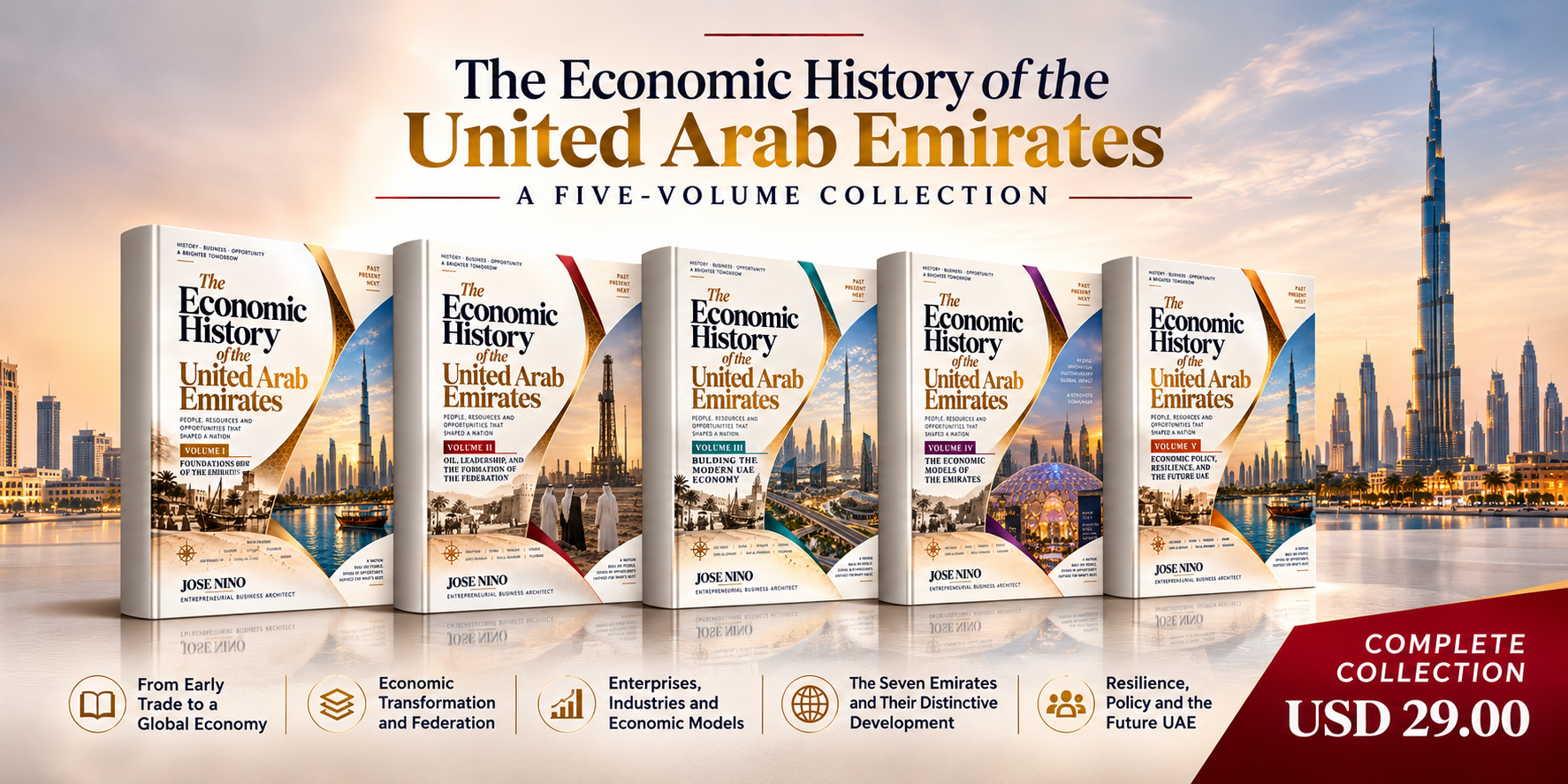
The history of the UAE is a story of economic opportunity, leadership, commercial development, institutional transformation, and the construction of capabilities that contributed to the country's emergence as a major international economy. Understanding that history provides entrepreneurs with a deeper perspective on the economic environment in which they intend to establish and develop their businesses.
The Economic History of the United Arab Emirates, by Jose Nino, examines these developments through a comprehensive five-volume collection. Volume I, Foundations of the Emirates, explores the geographical, commercial, political, and institutional foundations of the territories that would eventually form the United Arab Emirates, including the ruling families whose historical development influenced the individual emirates.
The complete collection continues through the petroleum era, the formation of the federation, the construction of modern economic institutions, the enterprises that contributed to national development, the different economic models of the seven emirates, and the challenges shaping the UAE's future.
Complete Five-Volume Digital PDF Collection — USD 29.99
From Entrepreneurial Vision to Establishing Your Business in Dubai
Understanding the relationship between leadership, economic opportunity, and organizational development can help entrepreneurs prepare more effectively for establishing a business in the UAE. However, translating a business idea into an operating enterprise also requires practical decisions concerning company structure, commercial licensing, jurisdiction selection, and the arrangements necessary to conduct the proposed activity.
ONE Business Dubai supports entrepreneurs, founders, investors, and international companies seeking to establish businesses in Dubai and across the United Arab Emirates. Our company formation and business registration services assist clients with the initial establishment process, taking into consideration the proposed business activity, jurisdiction, and relevant registration requirements.
UAE Company Formation & Business Registration — Professional Fees from USD 1,200 + Government Fees
Professional service fees begin at USD 1,200, excluding applicable government fees and other required third-party charges. The final scope of services and estimated costs depend on the nature of the proposed enterprise and the jurisdiction in which it will be established.
Request UAE Company Formation & Business Registration Assistance
Build an Enterprise, Not Just a Business Registration
The historical development of the United Arab Emirates offers an important lesson about the relationship between leadership and economic transformation. Resources create possibilities, commercial relationships expand opportunities, and geographical conditions influence development, but durable economic capabilities require decisions, organization, and institutional continuity.
For entrepreneurs establishing businesses in Dubai today, this lesson extends beyond the administrative process of obtaining a commercial license. Registration creates the legal foundation of an enterprise, but the ability to generate revenue, serve customers, coordinate resources, and adapt to changing market conditions depends upon the organization that the founder develops.
A founder should therefore evaluate success not only through the establishment of a company or the achievement of its first commercial transactions, but also through the progressive development of capabilities that allow the enterprise to operate reliably and pursue opportunities over time.
The most important entrepreneurial achievement is not simply creating a company. It is building an organization capable of continuing to create value.
Discover the historical foundations of economic leadership, institutional development, and commercial transformation in The Economic History of the United Arab Emirates, the complete five-volume collection by Jose Nino.
Discover the Complete Five-Volume Collection — USD 29.99
Contact ONE Business Dubai for UAE Company Formation Services