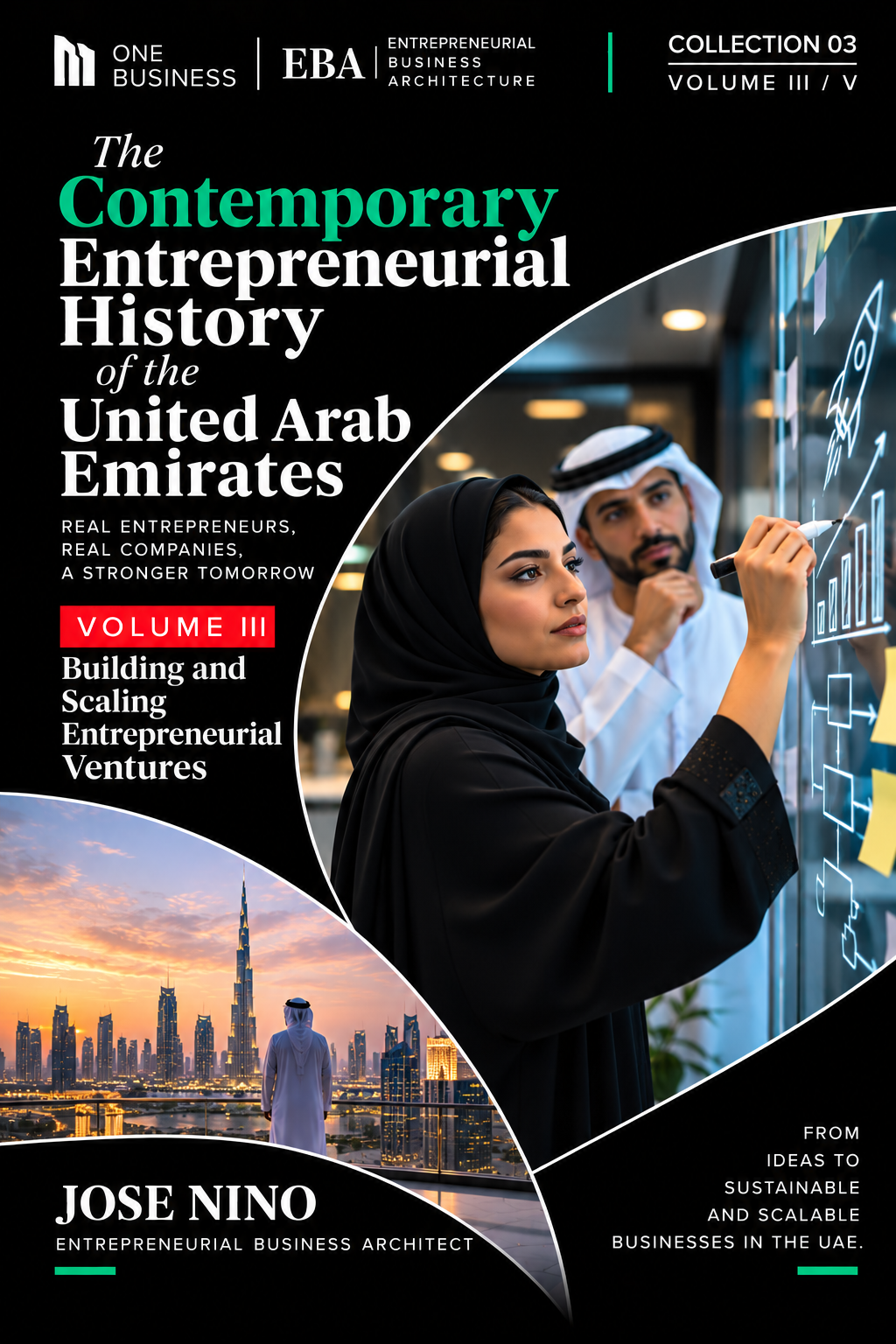
Official cover of The Contemporary Entrepreneurial History of the United Arab Emirates, Volume III
COLLECTION 03 · VOLUME III / V
ONE BUSINESS DUBAI / ENTREPRENEURIAL BOOKS
COLLECTION 03 / THE CONTEMPORARY ENTREPRENEURIAL HISTORY OF THE UAE

The Contemporary
Entrepreneurial History
of the United Arab Emirates

Volume III — Building and Scaling Entrepreneurial Ventures

Building businesses across diverse markets and operating models

Investigate the realities of venture creation, failure, reinvention and scaling across fintech, food operations, consumer brands, on-demand delivery, digital property marketplaces and agricultural innovation.

7 CHAPTERS227 NUMBERED SECTIONSFIRST EDITION · 2026
01 / ABOUT THIS VOLUME

Building and Scaling Entrepreneurial Ventures.

Investigate the realities of venture creation, failure, reinvention and scaling across fintech, food operations, consumer brands, on-demand delivery, digital property marketplaces and agricultural innovation.

This volume forms part of a five-volume historical study of contemporary entrepreneurs in the United Arab Emirates. It examines the actual founders, decisions, capabilities, operating challenges, businesses and market changes documented in the contemporary entrepreneurial record.

Read this volume as a historical study of individuals developing entrepreneurial capabilities, recognizing opportunities and building businesses in the UAE’s contemporary economic environment.

02 / WHY THIS BOOK MATTERS

Contemporary entrepreneurial history through the decisions of founders.

From digital marketplaces and venture investment to consumer brands, advanced ventures and business reinvention, the UAE presents a contemporary history of entrepreneurial action across many sectors.

The purpose of this work is to understand how contemporary entrepreneurs identified opportunities, organized resources, developed capabilities, attracted customers, built businesses and responded to uncertainty. Evidence about real ventures comes first; Entrepreneurial Business Architecture is used retrospectively to interpret relevant entrepreneurial relationships.

03 / WHAT YOU WILL DISCOVER

7 chapters. One part of a five-volume historical work.

Explore the subjects addressed in this volume using its verified chapter and section headings.

01

Failure, Shutdown and the Recycling of Entrepreneurial Capability

Why Failure Belongs in Entrepreneurial History · Failure Is Not One Thing

02

Fintech Entrepreneurs and the Reinvention of Financial Access

Opening — The Friction Inside the Transaction · From Digital Commerce to Digital Financial Friction

03

Kitopi and the Reinvention of Food Operations

Opening — The Restaurant That Could Not Scale Without · Mohamad Ballout Before Kitopi

04

Consumer Brands Born in the UAE: Huda Beauty and Global Audience Building

Opening — When an Audience Becomes a Market · Huda Kattan Before Huda Beauty

05

InstaShop, Delivery and the Acquisition Path

Opening — The Last Items in the Fridge · John Tsioris and Ioanna Angelidaki Before InstaShop

06

PropTech After Property Finder: Bayut, Dubizzle and the Digitalization of Classified Markets

Opening — When Search Became Competition · The Market Property Finder Helped Reveal

07

Pure Harvest and the Economics of Building Physical Capability

Opening — The Decision to Grow, Not Import · Sky Kurtz Before Pure Harvest

04 / COMPLETE BOOK CONTENTS

Explore what's inside.

Open each chapter to explore the actual numbered section headings from Volume III.

CHAPTER 13Failure, Shutdown and the Recycling of Entrepreneurial Capability
  1. 13.1Why Failure Belongs in Entrepreneurial History
  2. 13.2Failure Is Not One Thing
  3. 13.3The UAE Support Paradox
  4. 13.4Awok — Scale Without Sustainability
  5. 13.5Fetchr — Technical Insight Meets Physical Operating
  6. 13.6The Modist — Positioning, Demand and Capital
  7. 13.7Sprii — Specialized E-Commerce and Liquidation
  8. 13.8Nisnass — Corporate Backing Does Not Remove Market Risk
  9. 13.9Failure Before Shutdown — The Signals
  10. 13.10Product-Market Fit Can Be Absent or Erode
  11. 13.11Unit Economics as an Entrepreneurial Constraint
  12. 13.12Capital Can Delay the Market Verdict
  13. 13.13Scale Can Magnify Weakness
  14. 13.14Failure and Founder Capability
  15. 13.15Failure and Employee Capability
  16. 13.16Failure and Investor Learning
  17. 13.17Failure and Market Learning
  18. 13.18What Survives a Failed Business?
  19. 13.19What Can Disappear?
  20. 13.20Capability Recycling — The Central Research Problem
  21. 13.21Second Attempts and Entrepreneurial Reinvention
  22. 13.22Failure, Stigma and Entrepreneurial Re-Entry
  23. 13.23Entrepreneurial Resilience — Outcome, Not Architecture
  24. 13.24EBA Reconstruction of Failure
  25. 13.25Network Architecture of Failure and Recycling
  26. 13.26Ecosystem Feedback from Failure
  27. 13.27Entrepreneurial Architecture Research Contributions
  28. 13.28Chapter Synthesis — Failure, Residue and Recycling
  29. 13.29Entrepreneurial Lessons
  30. 13.30Part III Synthesis — What Makes Scale Possible, and What
  31. 13.31Chapter Close and Transition
CHAPTER 14Fintech Entrepreneurs and the Reinvention of Financial Access
  1. 14.1Opening — The Friction Inside the Transaction
  2. 14.2From Digital Commerce to Digital Financial Friction
  3. 14.3Founder Experience as Opportunity-Sensing Capability
  4. 14.4Khalil Alami and Telr — Merchant Acceptance as
  5. 14.5Sarwa — Making Investing Accessible Through a Regulated
  6. 14.6Hosam Arab, Daniil Barkalov and Tabby — Credit Embedded
  7. 14.7Ziina — From Peer-to-Peer Transfers Toward Business
  8. 14.8Mamo — Professional Technology Capability Meets SME
  9. 14.9Five Frictions, Five Business Architectures
  10. 14.10Regulation as Business-Design Constraint
  11. 14.11Regulatory Capability
  12. 14.12Sandboxes and Controlled Experimentation
  13. 14.13Trust as a Business Requirement
  14. 14.14Banks as Partners, Infrastructure and Possible Competitors
  15. 14.15Merchants as Customers and Distribution Networks
  16. 14.16B2B and B2C Fintech Require Different Capabilities
  17. 14.17Capital and Fintech
  18. 14.18Talent and Fintech Capability
  19. 14.19Financial Access — Define What Actually Changed
  20. 14.20Market Validation in Fintech
  21. 14.21Regional Scale and Regulatory Fragmentation
  22. 14.22Failure, Friction and Fintech Discipline
  23. 14.23EBA Reconstruction of Fintech Entrepreneurship
  24. 14.24Network Architecture of Fintech Entrepreneurship
  25. 14.25Ecosystem-Enabled Capability Development
  26. 14.26Entrepreneurial Architecture Research Contributions
  27. 14.27Chapter Synthesis — From Friction to Financial Access
  28. 14.28Entrepreneurial Lessons
  29. 14.29Close and Transition
CHAPTER 15Kitopi and the Reinvention of Food Operations
  1. 15.1Opening — The Restaurant That Could Not Scale Without
  2. 15.2Mohamad Ballout Before Kitopi
  3. 15.3The Co-Founding Team
  4. 15.4Discovering the Real Constraint
  5. 15.5The Original Kitopi Hypothesis
  6. 15.6Kitopi Was Not Just a Cloud-Kitchen Landlord
  7. 15.7Control Without Brand Ownership
  8. 15.8The Partner-Brand Value Proposition
  9. 15.9Building the Physical Production System
  10. 15.10Procurement and Supply Chain
  11. 15.11People Make the Platform Physical
  12. 15.12Technology as an Operating System
  13. 15.13The Customer Promise
  14. 15.14Delivery Platforms and Dependency
  15. 15.15Density and the Economics of Physical-Digital Operations
  16. 15.16Capital Before and During Scale
  17. 15.17Replication Across Kitchens
  18. 15.18Regional Expansion
  19. 15.19COVID-19 as Stress Test and Demand Shock
  20. 15.20From Partner Operator Toward Brand Ownership /
  21. 15.21Kitopi's Business-Model Evolution
  22. 15.22What Actually Scaled?
  23. 15.23Failure Modes of the Model
  24. 15.24EBA Reconstruction
  25. 15.25Network Architecture of Kitopi
  26. 15.26Ecosystem-Enabled Capability Development
  27. 15.27Entrepreneurial Architecture Research Contributions
  28. 15.28Chapter Synthesis — The Operating Platform
  29. 15.29Entrepreneurial Lessons
  30. 15.30Close and Transition
CHAPTER 16Consumer Brands Born in the UAE: Huda Beauty and Global Audience Building
  1. 16.1Opening — When an Audience Becomes a Market
  2. 16.2Huda Kattan Before Huda Beauty
  3. 16.3The Blog and the Creation of an Audience
  4. 16.4Audience as Entrepreneurial Information
  5. 16.5The First Product Opportunity — False Eyelashes
  6. 16.6Mona and Alya Kattan — Family as Founding Capability
  7. 16.7Sephora and the Retail Gateway
  8. 16.8From Audience to Customer
  9. 16.9Attention Capital — Useful but Incomplete
  10. 16.10Building Products Beyond the First Hit
  11. 16.11From Personal Brand to Product Brand
  12. 16.12Social Media as Distribution, Research and Relationship
  13. 16.13The Physical Product System Behind the Digital Brand
  14. 16.14Retail Distribution as Organizational Capability
  15. 16.15Dubai as a Base for a Global Consumer Brand
  16. 16.16Global Market Development
  17. 16.17Brand Across Cultures
  18. 16.18Capital, Investment and Ownership
  19. 16.19Organizational Development — When the Founder Cannot Be
  20. 16.20Leadership, Governance and Founder Return
  21. 16.21The Risk of Founder Dependence
  22. 16.22Competition and the Global Beauty Industry
  23. 16.23Failure, Discontinuation and Product Learning
  24. 16.24Huda Beauty Versus the Generic Influencer Brand
  25. 16.25EBA Reconstruction
  26. 16.26Network Architecture of Audience-Led Entrepreneurship
  27. 16.27Ecosystem-Enabled Capability Development
  28. 16.28Entrepreneurial Architecture Research Contributions
  29. 16.29Chapter Synthesis — From Attention to Enterprise
  30. 16.30Entrepreneurial Lessons
  31. 16.31Close and Transition
CHAPTER 17InstaShop, Delivery and the Acquisition Path
  1. 17.1Opening — The Last Items in the Fridge
  2. 17.2John Tsioris and Ioanna Angelidaki Before InstaShop
  3. 17.3Discovering the Grocery Coordination Problem
  4. 17.4The Original Business Hypothesis
  5. 17.5Why Grocery Was Different from General E-Commerce
  6. 17.6Building the Store Side of the Marketplace
  7. 17.7Building the Customer Side
  8. 17.8Inventory Without Owning Inventory
  9. 17.9The Physical Promise Behind the App
  10. 17.10Density as a Business Variable
  11. 17.11Repeat Behavior as Market Validation
  12. 17.12Marketplace Economics
  13. 17.13Capital and Capital Discipline
  14. 17.14From Dubai Neighborhoods to a Replicable Market Model
  15. 17.15What Had to Be Local
  16. 17.16What Could Be Replicated
  17. 17.17Competition and Quickening Customer Expectations
  18. 17.18COVID-19 — Demand Shock, Capacity Test and Historical
  19. 17.19Delivery Hero Before the Transaction
  20. 17.20Why Buy InstaShop?
  21. 17.21The Acquisition
  22. 17.22Acquisition Price Is Not the Whole Entrepreneurial Story
  23. 17.23Post-Acquisition Integration
  24. 17.24What Survived the Acquisition?
  25. 17.25Acquisition as Capability Transfer
  26. 17.26Founders After the Transaction
  27. 17.27Comparative Mini-Lens — Carriage, Talabat and Regional
  28. 17.28EBA Reconstruction
  29. 17.29Network Architecture of InstaShop
  30. 17.30Ecosystem-Enabled Capability Development
  31. 17.31Entrepreneurial Architecture Research Contributions
  32. 17.32Chapter Synthesis — From Local Coordination to Strategic
  33. 17.33Entrepreneurial Lessons
  34. 17.34Close and Transition
CHAPTER 18PropTech After Property Finder: Bayut, Dubizzle and the Digitalization of Classified Markets
  1. 18.1Opening — When Search Became Competition
  2. 18.2The Market Property Finder Helped Reveal
  3. 18.3Bayut — Founder Origins and Initial Hypothesis
  4. 18.4Bayut's Property Marketplace Problem
  5. 18.5Building Supply — Agents, Developers and Listings
  6. 18.6Building Demand — Searchers, Buyers and Renters
  7. 18.7Leads as the Economic Bridge
  8. 18.8Trust and Listing Quality
  9. 18.9Marketplace Liquidity
  10. 18.10Data as a By-Product of Marketplace Activity
  11. 18.11B2B Tools Beyond Advertising
  12. 18.12Dubizzle — A Different Entrepreneurial Origin
  13. 18.13The General Classifieds Model
  14. 18.14Liquidity Across Multiple Categories
  15. 18.15Trust in Peer-to-Peer Classifieds
  16. 18.16Property Inside Dubizzle
  17. 18.17Two Marketplace Paths
  18. 18.18Competition with Property Finder
  19. 18.19The Cost of Marketplace Competition
  20. 18.20Property Cycles as a Stress Test
  21. 18.21Geographic Expansion and Local Market Reconstruction
  22. 18.22EMPG and the Regional Marketplace Strategy
  23. 18.23Dubizzle Ownership Evolution
  24. 18.24Bayut + Dubizzle Under Common Ownership
  25. 18.25Consolidation as Market Reconfiguration
  26. 18.26What Was Actually Consolidated?
  27. 18.27Digitalization Does Not Complete the Property Transaction
  28. 18.28EBA Reconstruction
  29. 18.29Network Architecture of Classified Markets
  30. 18.30Ecosystem-Enabled Capability Development
  31. 18.31Entrepreneurial Architecture Research Contributions
  32. 18.32Chapter Synthesis — From Digitization to Market
  33. 18.33Entrepreneurial Lessons
  34. 18.34Close and Transition
CHAPTER 19Pure Harvest and the Economics of Building Physical Capability
  1. 19.1Opening — The Decision to Grow, Not Import
  2. 19.2Sky Kurtz Before Pure Harvest
  3. 19.3Seeing the Problem
  4. 19.4The Entrepreneurial Reframing
  5. 19.5Build, Import or Advise?
  6. 19.6The Founding of Pure Harvest
  7. 19.7Raising Capital Before Full Validation
  8. 19.8The First Site
  9. 19.9Technology Selection Is Not Capability
  10. 19.10Building the Agricultural Team
  11. 19.11First Crop, First Operating Truth
  12. 19.12Climate Control as an Economic System
  13. 19.13Water — Advantage, Cost and Evidence
  14. 19.14Energy — The Harder Counterweight
  15. 19.15Crop Selection as Entrepreneurial Strategy
  16. 19.16From Agricultural Output to Sellable Product
  17. 19.17The First Customers
  18. 19.18Retail Shelf as Market Test
  19. 19.19The Economics of Physical Capability
  20. 19.20Operating Learning
  21. 19.21From One Facility to Replication
  22. 19.22Capital for Scale
  23. 19.23UAE Expansion
  24. 19.24Regional Expansion
  25. 19.25Supply-Chain Capability
  26. 19.26Import Substitution — Use with Discipline
  27. 19.27Competition
  28. 19.28Failure Modes and Operating Risk
  29. 19.29COVID, Supply Shocks and Resilience
  30. 19.30What Did Sky Kurtz Actually Build?
  31. 19.31Founder Capability → Organizational Capability
  32. 19.32EBA Reconstruction
  33. 19.33Network Architecture of Physical Production
  34. 19.34Ecosystem-Enabled Capability Development
  35. 19.35Entrepreneurial Architecture Research Contributions
  36. 19.36Chapter Synthesis — From Asset to Capability
  37. 19.37Entrepreneurial Lessons
  38. 19.38Close and Transition
ALSO INCLUDED

Volume introduction · Historical analysis · Entrepreneurial interpretation

05 / THE CONTEMPORARY ENTREPRENEURIAL HISTORY OF THE UAE
3/05

COLLECTION 03 · FIVE VOLUMES

One volume in a five-part historical study.

The Contemporary Entrepreneurial History of the United Arab Emirates examines founders, digital markets, capital and professional networks, diverse ventures, ecosystem change and the circulation of entrepreneurial capability in the contemporary UAE.

Each volume can be studied separately or as part of the complete collection.

EXPLORE THE COMPLETE COLLECTION ↗
06 / WHO THIS BOOK IS FOR

For readers interested in the people building the contemporary entrepreneurial UAE.

This work is intended for entrepreneurs, business owners, students, researchers and readers interested in the entrepreneurial history of the UAE and the processes through which economic capabilities, enterprises and markets develop.

Its contemporary case studies illuminate capability development, opportunity discovery, business creation, market development, adaptation and growth while recognizing the uncertainty and limitations faced by individual founders.

07 / THE ENTREPRENEURIAL PERSPECTIVE

History as knowledge for entrepreneurial thinking.

Entrepreneurial Business Architecture connects personal development, entrepreneurial capability, opportunity discovery, business creation and sustainable entrepreneurial development.

These volumes examine entrepreneurs and enterprises within their own historical circumstances, then draw analytical lessons where warranted by the evidence. They do not suggest that historical actors were consciously applying a contemporary EBA framework.

EXPLORE ENTREPRENEURIAL KNOWLEDGE ↗
08 / GET YOUR COPY

Explore Volume III.

Choose this volume or explore the complete five-volume collection. Complete your order form before secure payment through Stripe. Your PDF will be sent by email after payment confirmation.
INDIVIDUAL VOLUME

Volume III · Digital Edition

Building and Scaling Entrepreneurial Ventures

USD $6.99
SECURE CHECKOUT · STRIPEBUY VOLUME ↗

Complete the order form, continue to secure Stripe payment, and receive your PDF by email after payment confirmation.

ONE BUSINESS DUBAI

Personal Transformation.
Entrepreneurial Development.
Economic Opportunity.

Advancing personal transformation, entrepreneurial development, and the creation of economic opportunity in Dubai and the UAE.

ONE BUSINESS DUBAI / CONTACT

Get in touch.

Have a question about our knowledge, books, or education? Send us a message.

We use your information to respond to your inquiry and collect your IP address for security and to understand the origin of inquiries. Submissions are processed by our FormMail server.

You can also email us directly at[email protected]