COLLECTION 03 / THE CONTEMPORARY ENTREPRENEURIAL HISTORY OF THE UAE
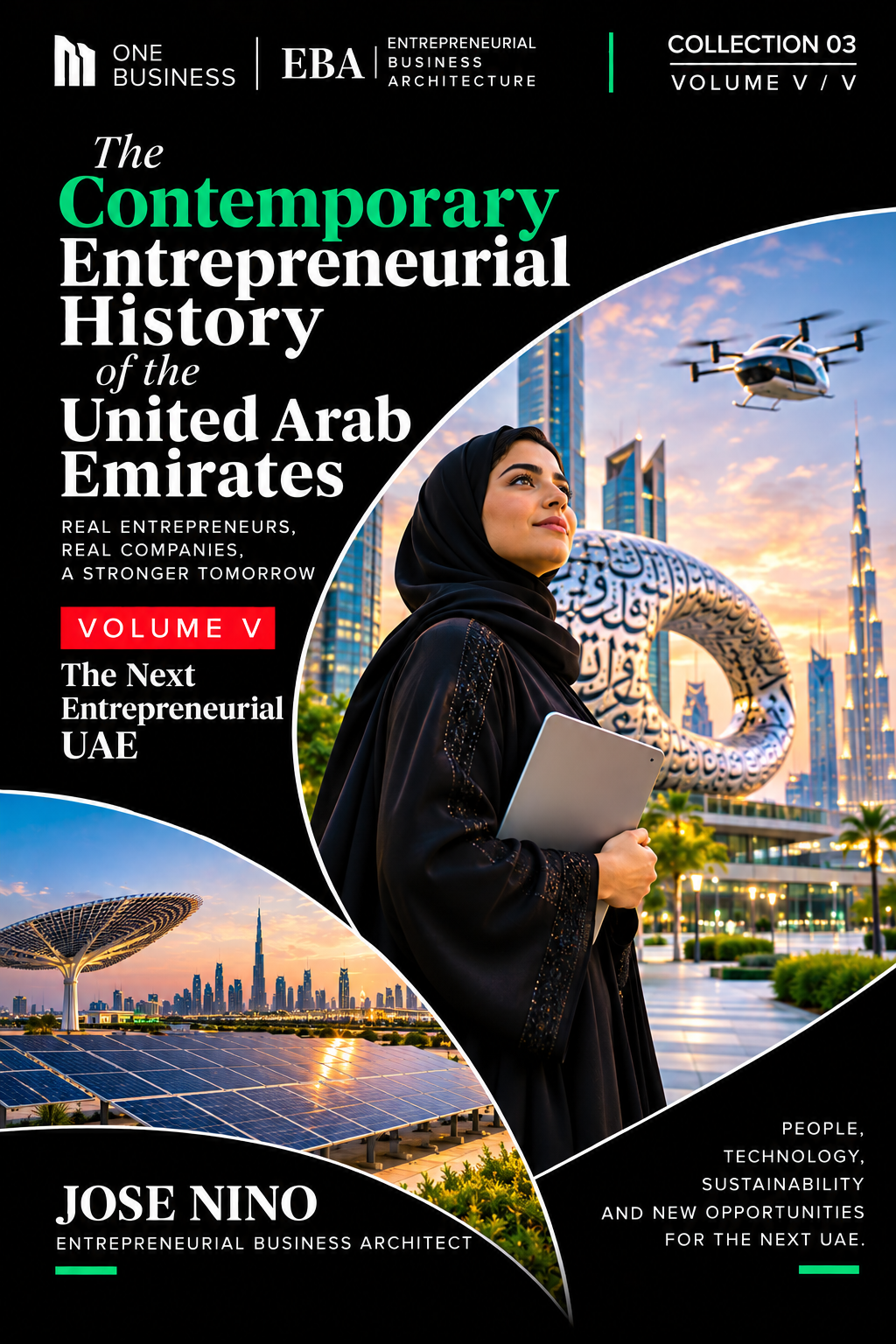
The Contemporary Entrepreneurial History of the United Arab Emirates
Volume V — The Next Entrepreneurial UAE
How experience and capability can enable future entrepreneurs
Understand how experience, acquisitions, entrepreneurial alumni, family enterprises and emerging technologies may contribute to the repeated creation of new ventures in the UAE.
Understand how experience, acquisitions, entrepreneurial alumni, family enterprises and emerging technologies may contribute to the repeated creation of new ventures in the UAE.
This volume forms part of a five-volume historical study of contemporary entrepreneurs in the United Arab Emirates. It examines the actual founders, decisions, capabilities, operating challenges, businesses and market changes documented in the contemporary entrepreneurial record.
Read this volume as a historical study of individuals developing entrepreneurial capabilities, recognizing opportunities and building businesses in the UAE’s contemporary economic environment.
02 / WHY THIS BOOK MATTERS
Contemporary entrepreneurial history through the decisions of founders.
From digital marketplaces and venture investment to consumer brands, advanced ventures and business reinvention, the UAE presents a contemporary history of entrepreneurial action across many sectors.
The purpose of this work is to understand how contemporary entrepreneurs identified opportunities, organized resources, developed capabilities, attracted customers, built businesses and responded to uncertainty. Evidence about real ventures comes first; Entrepreneurial Business Architecture is used retrospectively to interpret relevant entrepreneurial relationships.
03 / WHAT YOU WILL DISCOVER
6 chapters. One part of a five-volume historical work.
Explore the subjects addressed in this volume using its verified chapter and section headings.
01
Family Enterprise Reinvention and the Contemporary Entrepreneur
Opening — The Business Already Exists · Book 2 to Book 3 — From Founding Families to Contemporary
02
Acquisitions, Exits and the Creation of Entrepreneurial Liquidity
Opening — What Happens the Day After the Exit? · Why Exits Matter to Entrepreneurial History
03
From Employees to Founders: The Entrepreneurial Alumni Effect
Opening — the Company as A School without Being A School · From Exit Recycling to Human Reproduction
04
The Entrepreneurial Geography Revisited: Dubai, Abu Dhabi, Sharjah and Beyond
Opening — A Founder's UAE Is Not a Map · Why Revisit Entrepreneurial Geography Now?
05
The Newest Wave: AI, Sustainability And Emerging Entrepreneurial Models
Opening — Writing History Before The Outcome Is Known · The Newest Wave Starts From A Different Baseline
06
The Contemporary Entrepreneurial UAE: From Exceptional Founders To Repeated Entrepreneurship
Opening — After the Exceptional Founder · From Heroic Entrepreneurship to Reproducible
04 / COMPLETE BOOK CONTENTS
Explore what's inside.
Open each chapter to explore the actual numbered section headings from Volume V.
CHAPTER 27Family Enterprise Reinvention and the Contemporary Entrepreneur+
27.1Opening — The Business Already Exists
27.2Book 2 to Book 3 — From Founding Families to Contemporary
27.3The Four Roles That Must Be Separated
27.4What Is Inherited?
27.5What Cannot Simply Be Inherited?
27.6The Family Enterprise as Capability Stock
27.7The Family Enterprise as Constraint
27.8Case Portfolio — Evidence Before Family Name
27.9Case A — The Person Before Succession
27.10Case A — Entry into the Family Enterprise
27.11Case A — The Entrepreneurial Departure
27.12Case A — Resource Leverage Versus Capability Creation
27.13Case A — Market Test
27.14Case B — Core-Business Reinvention
27.15Case B — Cannibalization and Legacy Risk
27.16Case C — New Venture from Family Platform
27.17Case C — Autonomy
27.18Case D — International / New-Market Recombination
27.19Case E / F — Evidence-Gated
27.20External Experience Before Family Return
27.21Family Socialization as Pre-Entrepreneurial Learning
27.22Intergenerational Capability Transfer
27.23Intergenerational Capability Loss
27.24Capability Recombination
27.25Capability Replacement
27.26Governance and Entrepreneurial Freedom
27.27Capital — Patient Resource or Soft Constraint?
27.28Reputation
27.29Network Inheritance
27.30Professionalization
27.31Digital Transformation — The Evidence Test
27.32Diversification
27.33Failure and Aborted Reinvention
27.34Family Enterprise Resilience
27.35From Family Capability to Ecosystem Capability
27.36EBA Comparative Reconstruction
27.37Capability Architecture
27.38Network Architecture
27.39Ecosystem-Enabled Capability Development
27.40Entrepreneurial Architecture Research Contributions
CHAPTER 28Acquisitions, Exits and the Creation of Entrepreneurial Liquidity+
28.1Opening — What Happens the Day After the Exit?
28.2Why Exits Matter to Entrepreneurial History
28.3Define Entrepreneurial Liquidity Carefully
28.4Five Post-Exit Flows
28.5Case A — Souq Before Amazon
28.6Souq → Amazon — Transaction Reconstruction
28.7Souq After the Transaction
28.8What Souq Actually Recycled
28.9Case B — Careem Before Uber
28.10Careem → Uber — Transaction Reconstruction
28.11Careem Founders After the Exit
28.12Careem Employees After the Exit
28.13Careem Investor Capital
28.14Careem Restructuring and Capability Retention
28.15Case C — InstaShop → Delivery Hero
28.16Founder Continuity After Acquisition
28.17Additional Case D — Namshi
28.18Additional Case E — Mumzworld
28.19Who Actually Gets Liquidity?
28.20Founder Liquidity
28.21Employee Liquidity
28.22Investor Liquidity
28.23Capital Recycling
28.24Founder Recycling
28.25Talent Recycling
28.26Knowledge Recycling
28.27Network Recycling
28.28Credibility and Signalling
28.29The Foreign-Acquirer Question
28.30Capability Retention
28.31Capability Leakage
28.32Acquisition as Capability Transfer to the Buyer
28.33Acquisition as Capability Preservation
28.34Acquisition as Capability Destruction
28.35Exit Timing and Founder Judgment
28.36Failure to Exit
28.37EBA and the Exit Boundary
28.38Network Architecture After Exit
28.39Ecosystem Feedback — Strict Test
28.40Entrepreneurial Architecture Research Contributions
CHAPTER 29From Employees to Founders: The Entrepreneurial Alumni Effect+
29.1Opening — the Company as A School without Being A School
29.2From Exit Recycling to Human Reproduction
29.3Why Employees May Matter More Than Founders for Ecosystem Reproduction
29.4What Is An Entrepreneurial Firm as A Capability
29.5The Careem Alumni Research Program
29.6Careem — What Could Employees Have Learned?
29.7Careem Alumni Case A — Person Before Careem
29.8Case A — Role Inside Careem
29.9Case A — Departure and Opportunity
29.10Case A — New Venture
29.11Case A — Capability Linkage
29.12Careem Alumni Case B
29.13Careem Alumni Case C
29.14Careem Alumni Case D / E — Evidence Gate
29.15The Souq Alumni Research Program
29.16Souq — What Could Employees Have Learned?
29.17Souq Alumni Case A
29.18Souq Alumni Case B
29.19Souq Alumni Case C / D — Evidence Gate
29.20Other UAE Entrepreneurial Firms as Founder Generators
29.21Pre-Existing Human Capital — the Attribution Problem
29.22Selection Effect
29.23Development Effect
29.24Selection × Development
29.25Intensity of Responsibility
29.26Learning Under Uncertainty
29.27Tacit Knowledge
29.28Failure Inside the Origin Company
29.29Network Formation Inside the Firm
29.30Cofounder Formation
29.31Investor Access
29.32Customer / Partner Access
29.33Employee Equity and Risk Capacity
29.34The Role of the Exit
29.35Alumni Network Persistence
29.36Alumni Network Evolution
29.37Geographic Retention
29.38Capability Leakage Through Alumni
29.39Failed Alumni Ventures
29.40The Organizational Origin of Entrepreneurial Capability
CHAPTER 30The Entrepreneurial Geography Revisited: Dubai, Abu Dhabi, Sharjah and Beyond+
30.1Opening — A Founder's UAE Is Not a Map
30.2Why Revisit Entrepreneurial Geography Now?
30.3Reconstructing Earlier Dubai and Abu Dhabi Research
30.4The UAE as a Differentiated Entrepreneurial Environment
30.5The UAE as a Connected Entrepreneurial Environment
30.6Dubai — Founder Case A
30.7Dubai — Commercial Density and Founder Access
30.8Dubai — Customers and Corporate Markets
30.9Dubai — International Connectivity in Practice
30.10Dubai — Competition as a Capability Pressure
30.11Dubai — Cost, Entry, and Network Constraints
30.12Abu Dhabi — Founder Case B
30.13Abu Dhabi — Capital Presence Versus Capital Access
30.14Abu Dhabi — Research and Technology Connections
30.15Abu Dhabi — Customer Structure and Procurement
30.16Abu Dhabi — Capability Development and Institutional
30.17Sharjah — Founder Case C
30.18Sharjah — Universities, Knowledge, and Youth
30.19Sharjah — Industrial, Creative, and Cultural Enterprise
30.20Sharjah — Proximity to Dubai as a Business Decision
30.21Ras Al Khaimah — Evidence-Gated Entrepreneurial Pathways
05 / THE CONTEMPORARY ENTREPRENEURIAL HISTORY OF THE UAE
5/05
COLLECTION 03 · FIVE VOLUMES
One volume in a five-part historical study.
The Contemporary Entrepreneurial History of the United Arab Emirates examines founders, digital markets, capital and professional networks, diverse ventures, ecosystem change and the circulation of entrepreneurial capability in the contemporary UAE.
Each volume can be studied separately or as part of the complete collection.
For readers interested in the people building the contemporary entrepreneurial UAE.
This work is intended for entrepreneurs, business owners, students, researchers and readers interested in the entrepreneurial history of the UAE and the processes through which economic capabilities, enterprises and markets develop.
Its contemporary case studies illuminate capability development, opportunity discovery, business creation, market development, adaptation and growth while recognizing the uncertainty and limitations faced by individual founders.
07 / THE ENTREPRENEURIAL PERSPECTIVE
History as knowledge for entrepreneurial thinking.
Entrepreneurial Business Architecture connects personal development, entrepreneurial capability, opportunity discovery, business creation and sustainable entrepreneurial development.
These volumes examine entrepreneurs and enterprises within their own historical circumstances, then draw analytical lessons where warranted by the evidence. They do not suggest that historical actors were consciously applying a contemporary EBA framework.
Choose this volume or explore the complete five-volume collection. Complete your order form before secure payment through Stripe. Your PDF will be sent by email after payment confirmation.