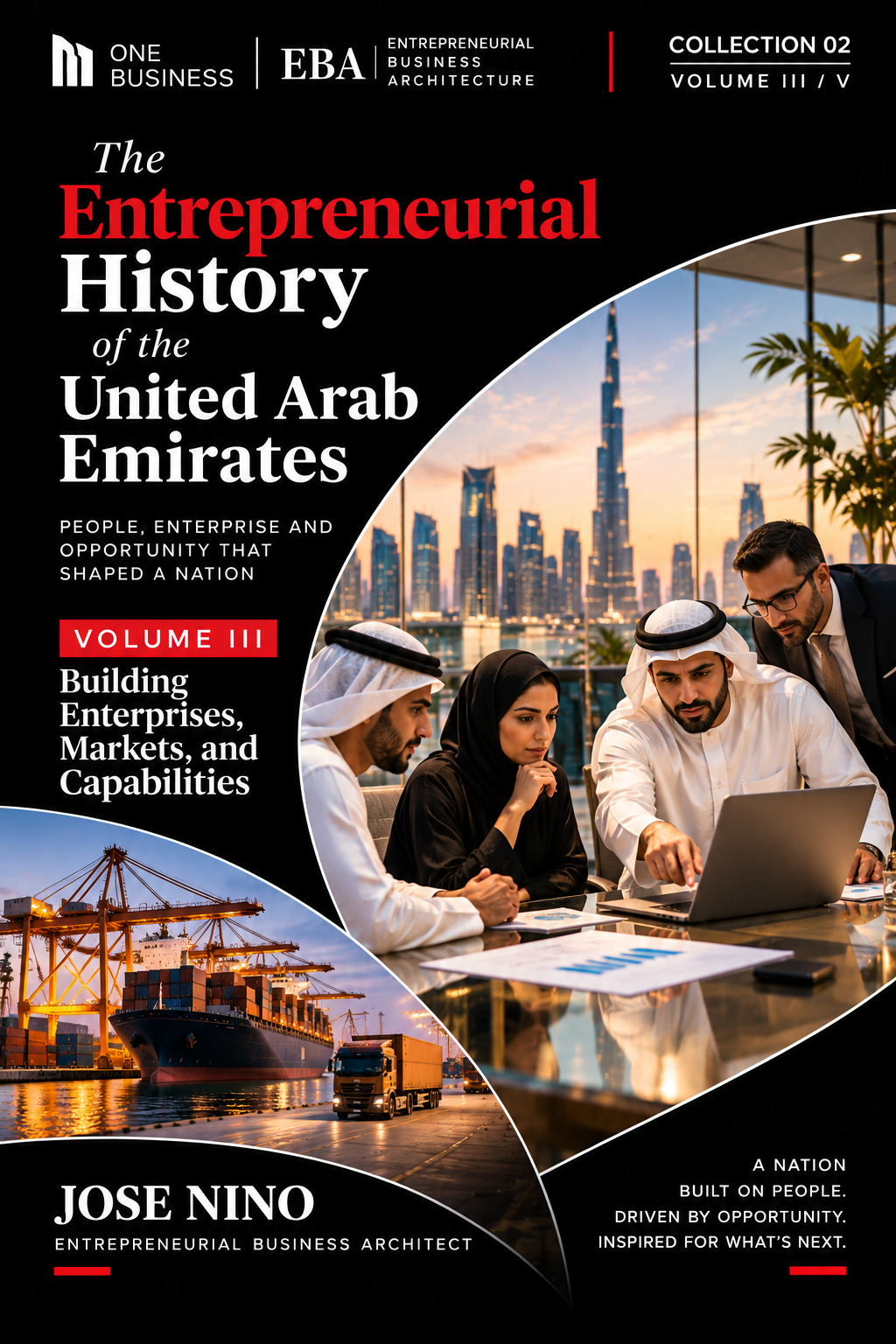
Official cover of The Entrepreneurial History of the United Arab Emirates, Volume III
COLLECTION 02 · VOLUME III / V
ONE BUSINESS DUBAI / ENTREPRENEURIAL BOOKS
COLLECTION 02 / THE ENTREPRENEURIAL HISTORY OF THE UAE

The Entrepreneurial
History of the
United Arab Emirates

Volume III — Building Enterprises, Markets, and Capabilities

Entrepreneurs who built enterprises and markets

Examine founders, business families and entrepreneurial communities who developed new industries, customer experiences, productive capabilities and expanding markets.
11 CHAPTERS126 NUMBERED SECTIONSFIRST EDITION · 2026
01 / ABOUT THIS VOLUME

Building Enterprises, Markets, and Capabilities.

Examine founders, business families and entrepreneurial communities who developed new industries, customer experiences, productive capabilities and expanding markets.

This volume forms part of a five-volume examination of the entrepreneurial history of the United Arab Emirates. It traces the people, commercial decisions, capabilities, relationships, enterprises and opportunities that shaped business development through different stages of the nation’s history.

Read the volume as a historical study of how individuals recognized opportunities, accumulated capabilities, built enterprises and transformed their economic circumstances.

02 / WHY THIS BOOK MATTERS

Entrepreneurial history through the actions of people.

From trading communities and visionary rulers to family enterprises, digital founders and emerging entrepreneurial opportunities, the UAE presents a rich history of people creating and developing businesses.

The purpose of this work is to understand how entrepreneurs identified opportunities, organized resources, built commercial trust, developed capabilities, entered markets and created enterprises. The history comes first; Entrepreneurial Business Architecture is used retrospectively to interpret relevant lessons without attributing a modern discipline to historical actors.

03 / WHAT YOU WILL DISCOVER

11 chapters. One part of a five-volume historical work.

Explore the subjects addressed in this volume using its verified chapter and section headings.

01

Jashanmal: Migration, Markets, and Entrepreneurial Networks

Examine founders, business families and entrepreneurial communities who developed new industries, customer experiences, productive capabilities and expanding markets.

02

Khansaheb: Building Enterprise Before the Federation

The People and Capabilities Behind Khansaheb's Origins · Entry into the Trucial States

03

Entrepreneurial Partnerships: Local Vision and Global Capability

Why Complementary Capability Was Needed · Local Knowledge as an Entrepreneurial Asset

04

Abdul Rahman Bukhatir: Leaving Security to Pursue Opportunity

Early Life, Education, and Professional Formation · The Secure Path

05

Women Entrepreneurs and the Transformation of the UAE

Women in Earlier Economic Life · Social and Economic Transformation

06

From Trading to Industry: Entrepreneurs Who Built Productive Capability

Why Trading Dominated Early Enterprise · The Opportunity for Local Production

07

Khater Massaad and RAK Ceramics: From Local Resources to Global Industry

Khater Massaad's Background and Capability · Ras Al Khaimah's Industrial Context

08

Majid Al Futtaim: Creating Markets Through Customer Experience

Entrepreneurial and Family Context · Identifying Changing Consumer Behavior

09

Khalaf Ahmad Al Habtoor: Entrepreneurial Leadership and Diversification

Early Life and Work · Learning the Construction Business

10

Mohamed Alabbar: From Enterprise Builder to Global Entrepreneur

Education and Early Career · Public-Sector and Development Experience

11

Hussain Sajwani: Risk, Crisis, and Entrepreneurial Reinvention

Early Life, Education, and Entrepreneurial Formation · From Employment to Business

04 / COMPLETE BOOK CONTENTS

Explore what's inside.

Open each chapter to explore the actual numbered section headings from Volume III.

CHAPTER 21Jashanmal: Migration, Markets, and Entrepreneurial Networks
    CHAPTER 22Khansaheb: Building Enterprise Before the Federation
    1. 22.1The People and Capabilities Behind Khansaheb's Origins
    2. 22.2Entry into the Trucial States
    3. 22.3Early Construction Opportunity
    4. 22.4Technical Knowledge and Local Adaptation
    5. 22.5Partnerships and Capability Transfer
    6. 22.6Logistics Under Constraint
    7. 22.7Execution and Reputation
    8. 22.8Participation in the Physical Development of the Emirates
    9. 22.9Organization and Continuity
    10. 22.10From Pre-Federation Contractor to Enduring Enterprise
    11. 22.11Khansaheb's Pre-Federation Capability Architecture
    12. 22.12The Khansaheb Pre-Federation Enterprise Capability Model
    CHAPTER 23Entrepreneurial Partnerships: Local Vision and Global Capability
    1. 23.1Why Complementary Capability Was Needed
    2. 23.2Local Knowledge as an Entrepreneurial Asset
    3. 23.3Global Technology, Brands, Expertise, and Systems
    4. 23.4Agencies and Distribution Partnerships
    5. 23.5Joint Ventures and Technical Partnerships
    6. 23.6Trust Across Institutional and Cultural Boundaries
    7. 23.7Learning and Capability Transfer
    8. 23.8Partnership Governance
    9. 23.9Dependency Risks
    10. 23.10From Representation to Internal Capability
    11. 23.11Partnership as an Entrepreneurial Mechanism
    12. 23.12The Local–Global Complementary Capability Mechanism
    CHAPTER 24Abdul Rahman Bukhatir: Leaving Security to Pursue Opportunity
    1. 24.1Early Life, Education, and Professional Formation
    2. 24.2The Secure Path
    3. 24.3Recognizing Entrepreneurial Possibility
    4. 24.4The Decision to Enter Business
    5. 24.5Early Ventures and Learning
    6. 24.6Building Enterprise Capability
    7. 24.7Sharjah and Emerging Opportunities
    8. 24.8Cricket as Market and Cultural Innovation
    9. 24.9Diversification
    10. 24.10Risk, Reputation, and Relationships
    11. 24.11Successes, Setbacks, and Adaptation
    12. 24.12The Bukhatir Entrepreneurial Commitment & Opportunity
    CHAPTER 25Women Entrepreneurs and the Transformation of the UAE
    1. 25.1Women in Earlier Economic Life
    2. 25.2Social and Economic Transformation
    3. 25.3Education and Capability Expansion
    4. 25.4Entry into Business and Professional Enterprise
    5. 25.5Institutional and Family Contexts
    6. 25.6Access to Networks, Capital, and Markets
    7. 25.7Emirati Women Entrepreneurs
    8. 25.8Expatriate Women Entrepreneurs
    9. 25.9Representative Founder Stories
    10. 25.10Women Across Sectors
    11. 25.11Barriers and Structural Change
    12. 25.12Networks and Ecosystem Support
    13. 25.13From Participation to Entrepreneurial Leadership
    14. 25.14The Next Generation
    CHAPTER 26From Trading to Industry: Entrepreneurs Who Built Productive Capability
    1. 26.1Why Trading Dominated Early Enterprise
    2. 26.2The Opportunity for Local Production
    3. 26.3Capital and Industrial Risk
    4. 26.4Technology and Technical Knowledge
    5. 26.5Manufacturing Operations
    6. 26.6Supply Chains and Inputs
    7. 26.7Workforce Capability
    8. 26.8Quality and Standards
    9. 26.9Building Domestic Demand
    10. 26.10Exporting from the UAE
    11. 26.11Representative Entrepreneurial Industrial Cases
    12. 26.12From Merchant Capability to Productive Capability
    CHAPTER 27Khater Massaad and RAK Ceramics: From Local Resources to Global Industry
    1. 27.1Khater Massaad's Background and Capability
    2. 27.2Ras Al Khaimah's Industrial Context
    3. 27.3Recognizing the Ceramics Opportunity
    4. 27.4Founding RAK Ceramics
    5. 27.5Relationship with Ras Al Khaimah Leadership
    6. 27.6Technology and Manufacturing Capability
    7. 27.7Quality, Cost, and Production Scale
    8. 27.8Export Market Development
    9. 27.9International Expansion
    10. 27.10Organization and Operational Complexity
    11. 27.11Entrepreneur–Government Complementarity
    12. 27.12Challenges, Leadership Transition, and Later Career Context
    13. 27.13RAK Ceramics: From Local Resources to Global Industrial
    CHAPTER 28Majid Al Futtaim: Creating Markets Through Customer Experience
    1. 28.1Entrepreneurial and Family Context
    2. 28.2Identifying Changing Consumer Behavior
    3. 28.3Separating a Distinct Entrepreneurial Path
    4. 28.4The Mall as More Than Real Estate
    5. 28.5Carrefour Partnership and Retail Anchoring
    6. 28.6Leisure and Entertainment
    7. 28.7Integrated Customer Experience
    8. 28.8Mall of the Emirates and Experiential Innovation
    9. 28.9Replication Across Markets
    10. 28.10Brand and Operating Systems
    11. 28.11Regional Scale
    12. 28.12Majid Al Futtaim Customer-Experience Market-Creation
    CHAPTER 29Khalaf Ahmad Al Habtoor: Entrepreneurial Leadership and Diversification
    1. 29.1Early Life and Work
    2. 29.2Learning the Construction Business
    3. 29.3Moving from Employment to Enterprise
    4. 29.4Building Al Habtoor Engineering
    5. 29.5Reputation Through Execution
    6. 29.6Opportunity Beyond Construction
    7. 29.7Hospitality and Real Estate
    8. 29.8Automotive and Other Diversification
    9. 29.9Founder-Led Decision Making
    10. 29.10Crisis, Risk, and Adaptation
    11. 29.11Governance and Generational Continuity
    12. 29.12Al Habtoor Diversification Architecture
    CHAPTER 30Mohamed Alabbar: From Enterprise Builder to Global Entrepreneur
    1. 30.1Education and Early Career
    2. 30.2Public-Sector and Development Experience
    3. 30.3The Context for Emaar
    4. 30.4Building a Real Estate Development Enterprise
    5. 30.5Scale, Brand, and Landmark Projects
    6. 30.6International Expansion
    7. 30.7From Corporate Builder to Serial Entrepreneur
    8. 30.8Digital Commerce and Noon
    9. 30.9Food, Technology, Investment, and Other Ventures
    10. 30.10Partnerships and Capital
    11. 30.11Failures, Challenges, and Strategic Adaptation
    12. 30.12Transferable Entrepreneurial Capability
    13. 30.13Alabbar's Transferable Enterprise-Building Capability Model
    CHAPTER 31Hussain Sajwani: Risk, Crisis, and Entrepreneurial Reinvention
    1. 31.1Early Life, Education, and Entrepreneurial Formation
    2. 31.2From Employment to Business
    3. 31.3Catering and Early Enterprise
    4. 31.4Recognizing the Dubai Property Opportunity
    5. 31.5Founding DAMAC
    6. 31.6Growth, Branding, and Market Positioning
    7. 31.7Capital, Pre-Sales, and Expansion
    8. 31.8The 2008–2009 Crisis
    9. 31.9Exposure, Retrenchment, and Adaptation
    10. 31.10Recovery and Rebuilding
    11. 31.11International Partnerships and Brand Strategy
    12. 31.12Privatization / Ownership Evolution Where Relevant
    13. 31.13New Investments and Reinvention
    14. 31.14Risk Configuration and Entrepreneurial Resilience
    ALSO INCLUDED

    Volume introduction · Historical analysis · Entrepreneurial interpretation

    05 / THE ENTREPRENEURIAL HISTORY OF THE UAE
    3/05

    COLLECTION 02 · FIVE VOLUMES

    One volume in a five-part historical study.

    The Entrepreneurial History of the United Arab Emirates traces entrepreneurial origins, visionary builders, merchant families, the development of enterprises and markets, international and digital entrepreneurs, and the next generation through the analytical perspective of EBA.

    Each volume can be studied separately or as part of the complete collection.

    EXPLORE THE COMPLETE COLLECTION ↗
    06 / WHO THIS BOOK IS FOR

    For readers seeking to understand how entrepreneurs build their futures.

    This work is intended for entrepreneurs, business owners, students, researchers and readers interested in the entrepreneurial history of the UAE and the processes through which economic capabilities, enterprises and markets develop.

    Its historical perspective is especially relevant to individuals seeking to understand entrepreneurial initiative, opportunity discovery, business creation, market development and the transformation of personal and economic realities.

    07 / THE ENTREPRENEURIAL PERSPECTIVE

    History as knowledge for entrepreneurial thinking.

    Entrepreneurial Business Architecture connects personal development, entrepreneurial capability, opportunity discovery, business creation and sustainable entrepreneurial development.

    These volumes examine entrepreneurs and enterprises within their own historical circumstances, then draw analytical lessons where warranted by the evidence. They do not suggest that historical actors were consciously applying a contemporary EBA framework.

    EXPLORE ENTREPRENEURIAL KNOWLEDGE ↗
    08 / GET YOUR COPY

    Explore Volume III.

    Choose this volume or explore the complete five-volume collection. Complete your order form before secure payment through Stripe. Your PDF will be sent by email after payment confirmation.

    INDIVIDUAL VOLUME

    Volume III · Digital Edition

    Building Enterprises, Markets, and Capabilities

    USD $6.99
    SECURE CHECKOUT · STRIPEBUY VOLUME ↗

    Complete the order form, continue to secure Stripe payment, and receive your PDF by email after payment confirmation.

    ONE BUSINESS DUBAI

    Personal Transformation.
    Entrepreneurial Development.
    Economic Opportunity.

    Advancing personal transformation, entrepreneurial development, and the creation of economic opportunity in Dubai and the UAE.

    ONE BUSINESS DUBAI / CONTACT

    Get in touch.

    Have a question about our knowledge, books, or education? Send us a message.

    We use your information to respond to your inquiry and collect your IP address for security and to understand the origin of inquiries. Submissions are processed by our FormMail server.

    You can also email us directly at[email protected]